
Defenseman Sebastian Aho Signs In Sweden
Former New York Islanders defenseman Sebastian Aho has signed with the Växjö Lakers of the SHL, the team announced today. The deal ends his nine year term in North America, the last two of which were spent with the Wilkes-Barre/Scranton Penguins of the AHL.
Today’s news is not much of a surprise, as back in February the 30-year-old was expected to return home to Sweden with Växjö. Despite playing in 129 regular season games between his last two years on Long Island from 2022-24, Aho was unable to secure another NHL opportunity. Signing with Pittsburgh for league-minimum two years ago, he did not see another shot at the highest level.
Aho put together a strong 2022-23 campaign for the Islanders, his best as a pro, notching 23 points in 71 games. He got into all six playoff contests for the club that spring, too, which caused some added difficulty for play-by-play announcers as New York took on Carolina, being defeated in six games. Of no relation to the Hurricanes star center of the same name, Aho’s puck-moving ability offers a skill not always seen as far as depth third-pairing options go, but at 5’10” 180 lbs, size held him back at the NHL level.
The type of player who often is a high scorer in the AHL, Aho dealt with injuries over the last two years with Wilkes-Barre, not managing more than 29 games in either season. The 2017 fifth-round selection recorded exactly 14 points each, passing through waivers twice as the output was not enough to catch the attention of another NHL franchise.
A product of Skellefteå AIK, the lefty will be a big addition to the Lakers whose defense corps were largely led by former Canuck and standout AHLer Brogan Rafferty last season, also featuring Keegan Lowe, son of Hall of Famer Kevin Lowe. One other expected future teammate of Aho worth mentioning is former Blackhawk and Duck Dennis Rasmussen, now 35, still a top scorer on the team. Växjö had a strong season in 2025-26, finishing third before an eventual defeat in the semi-finals, now eager to pick up an NHL-pedigree blueliner whose 190 NHL contests are a team-high.
Panthers And Penguins Swap Oliver Okuliar And Emil Pieniniemi
The Penguins and Panthers have made a swap of minor leaguers. Florida has acquired defenseman Emil Pieniniemi from Pittsburgh in exchange for the rights to forward Oliver Okuliar. Both teams have announced the swap.
Pieniniemi’s first season in the pros was a rocky one, to put it lightly. Assigned to the ECHL in October, the 21-year-old refused to report and was suspended indefinitely at the time. After more than two months, he ultimately changed his mind and got into 26 games with Wheeling during the regular season, where he had six goals and five assists. He also chipped in with eight points in 15 playoff contests.
Pieniniemi, a third-round pick in 2023, also got into nine AHL games with Wilkes-Barre/Scranton, picking up a goal and two assists. He has two seasons left on his entry-level contract, with a cap hit of just under $907K.
As for Okuliar, the winger signed a two-way deal as an undrafted free agent with Florida back in 2024 but played exclusively in the AHL. Despite a strong showing there where he had 19 goals and 22 assists along with 119 penalty minutes in 69 games with Charlotte, he opted to return overseas, signing a two-year deal with SHL Skelleftea.
This season, the 26-year-old played in 46 games in his first taste of that league, picking up 15 goals and 14 assists while adding 13 points in 15 postseason appearances. Okuliar also suited up internationally for Slovakia at both the Olympics and World Championship. He has one year of team control remaining as a restricted free agent.
Given how things transpired between the Penguins and Pieniniemi this season, it’s not overly surprising that the organization has decided to part ways with him. With the swap, Florida picks up a prospect for an asset that likely was going to be relinquished for free next summer. It will be interesting to see if Okuliar’s deal has an NHL out clause to see if Pittsburgh wants to bring him back to North America or if his inclusion is just a different form of future considerations.
Penguins Should Consider Signing Matt Murray
The Pittsburgh Penguins appear likely to lose goaltender Stuart Skinner in free agency when it hits on July 1st. Skinner was acquired during the season as part of the Tristan Jarry trade and was good for Pittsburgh, but was reportedly very well-liked in the dressing room. The Penguins are poised to go very young in net next season with the returning Arturs Silovs and rookie sensation Sergei Murashov. While those two have shown promise, neither is a sure thing, and the Penguins should be, and likely will be, on the hunt for a competent veteran who could step in if the team’s goaltending goes sideways. Enter former Penguins starting goaltender and two-time Stanley Cup champion Matt Murray, a netminder that Pittsburgh should seriously consider as their third-string option.
Now, Murray is no longer an NHL starter, and it’s fair to wonder whether his body can even hold up as a regular backup. But it’s still clear that he can play when healthy, given his body of work over the last two seasons. This past year in Seattle, Murray dressed for five games with the Kraken, going 0-2-1 with a .922 SV% and a 2.21 GAA before suffering an injury that sidelined him for most of the season. And therein lies the issue with Murray. He’s been hurt a lot.
The 32-year-old Murray has not played more than 30 games in a single season since the 2019-20 campaign, when he was still with the Penguins, and really can’t be expected to take regular starts given how his body has broken down. But Pittsburgh has what is perhaps the perfect role for him as their third stringer, and because Murray spent so much time on the injured reserve last year, he is eligible to sign an incentive-laden contract, which may be something he pursues.
Murray will likely be looking for an opportunity to get significant playing time if his body can hold up, which is why Pittsburgh might be the right fit for him. Pittsburgh could pay Murray NHL money, keep him up with the big club, and give him the occasional spot start to give Murashov and Silovs a rest, or they could bounce him back and forth between the AHL and the NHL and pay him his one-way salary. Either way, Murray collects his NHL paycheck, and the Penguins have their third-string safety net as well as Murray’s mentorship to assist Murashov and Silovs. That last piece, Murray’s ability to provide guidance to the Penguins’ young netminders, is perhaps the most important, as it would give Murashov the type of mentor that Murray had when he was a rookie, with Marc-Andre Fleury backing him up on the way to back-to-back Stanley Cups.
Murray is a very different personality from Fleury, but he’s been through everything a rookie can go through in the NHL (twice), and his disposition would be incredibly valuable to Murashov, while also giving Pittsburgh one of the better third options in the league. Murray could also provide valuable insight into mental and physical preparation, as well as the injuries and issues he’s dealt with since being traded by the Penguins. Murray’s career has gone off the rails, and it was hard to foresee that a decade ago, when he was leading the Penguins to back-to-back Stanley Cups. But with those tough times come tough lessons, and that could be invaluable information for both Murashov and Silovs.
The other part of this equation is that the Penguins realistically have their AHL tandem set for next season in Joel Blomqvist and Taylor Gauthier. Blomqvist will likely get the lion’s share of the AHL starts, and the Penguins might not want to disrupt that continuity if there is an injury at the NHL level. Having Murray available as a potential third goalie in the NHL would allow Pittsburgh to have that in place rather than shuttling a goalie back and forth if injuries come up, which they might.
Now, there are obviously some roster logistics at play if the Penguins were to keep three NHL goalies on the roster, and teams typically don’t like to do this. But if any organization knows how fragile a young goaltender can be, it’s the Penguins. This isn’t to say it’s the Penguins’ fault, but if you look back at the last 20 years, Fleury, Murray, and Tristan Jarry have all been the Penguins’ starters during that time, and all three were effectively broken at some point. Of the three, only Fleury was able to resurrect his career and continue, while Murray and Jarry have floundered despite early success.
Goaltending is perhaps the hardest position in sports to project, and you never really know how things will play out. The Penguins have a very special prospect in Murashov, and he has the talent to be an NHL superstar. Throwing him to the wolves without a safety net next season could be disastrous, especially given how allergic to defensive hockey the Penguins have historically been. Having Murray in the fold isn’t going to take a ton of pressure off Murashov, but it does give him an outlet, a mentor, and a safety net when he will need to navigate stormy waters. It also won’t cost the Penguins much, other than a roster spot and a league-minimum salary.
Morning Notes: Ott, Puustinen, McIlvane, NHLPA Rebrand
The St. Louis Blues have signed Steve Ott to a two-year contract extension, securing the 43-year-old as the Springfield Thunderbirds head coach through the 2027-28 season and keeping him within the St. Louis Blues organization.
Ott took over as head coach on January 19, 2026, after the Thunderbirds were struggling midseason. In the club’s final 34 regular-season games, he guided the team to an 18-14-2 record, clinching a sixth-seed playoff berth in the Atlantic Division. Ott then led Springfield to the Division Finals, with a first-round series win over the third-seeded Charlotte Checkers and a historic upset victory over the Providence Bruins in the Division Semifinals. The win over Providence marked the single-biggest upset in AHL history, with the teams separated by 38 points in the regular season.
“It’s a great opportunity for myself, but not only that, I get to stay in an organization that I truly love,” Ott said of the extension. “To help develop our young guys with the development side of coaching, it’s really exciting for myself. … When you get asked to take that opportunity, I look at it as a big honor.”
Additional Notes
- The NHLPA has restructured and rebranded its commercial business unit as the NHLPA Player Collective. The move aims to expand global business opportunities and partnerships for NHL players, building on recent staff additions like Chief Commercial Officer Steve Scebelo (formerly of NFL Players Inc.) to enhance player-driven commercial initiatives worldwide.
- Forward Valtteri Puustinen has signed with Luleå HF of the SHL. The 27-year-old Finnish winger split time last season between the Wilkes-Barre/Scranton Penguins and Colorado Eagles in the AHL after being traded from Pittsburgh to Colorado in January 2026. The 27-year-old recorded 77 goals and 189 points across 276 AHL games, seven goals and 24 points 66 NHL games with the Pittsburgh Penguins.
- The Boston Bruins are said to be hiring Matt McIlvane as an assistant coach. The 39-year-old spent the last three seasons as head coach of the San Diego Gulls, Anaheim’s AHL affiliate, where he earned a multi-year extension in April 2026 after previous success coaching in Europe.
Alexander Alexeyev Receiving KHL Interest
A fresh start for defenseman Alexander Alexeyev didn’t yield the NHL opportunity he was looking for this season. As a result, it appears as if he’s looking for a different type of fresh start this summer. Rustam Sharafutdinov of TASS reports that the blueliner is receiving KHL interest. His agent, Sergey Isakov, indicated that he has spoken with several KHL clubs about Alexeyev for next season, including Salavat Yulaev, the team he played for back in 2020-21.
The 26-year-old came up in Washington’s system after they drafted him 31st overall back in 2018. However, he was never able to establish himself in the NHL with the Capitals as he only suited up in 80 games over parts of four seasons, where he had a goal and seven assists in 15 minutes of playing time per game.
Washington decided to non-tender Alexeyev last summer, likely thanks in large part to his arbitration eligibility. The blueliner quickly signed a one-year, one-way deal worth $775K with the Penguins, hoping to be in the mix for a roster spot in training camp. Instead, he passed through waivers unclaimed in training camp and aside from a brief recall in mid-March, he was exclusively in the minors with AHL Wilkes-Barre/Scranton. Alexeyev had a dozen points in 38 games in the minors during the regular season while adding five more in 11 postseason contests.
Alexeyev is technically still eligible for restricted free agency this summer, although he remains arbitration-eligible. With that in mind, he’s likely heading for a non-tender once move. But this time, instead of waiting to see what offers might be available in July, Alexeyev appears to be eyeing an opportunity to play back home instead.
Joona Koppanen Signs With SHL’s Lulea HF
June 8th: Nearly three months later, Koppanen has finally left the Penguins organization. According to a report from Seth Rorabaugh of the Tribune-Review, Koppanen has signed with the SHL’s Luleå HF.
March 10th: Penguins pending UFA center Joona Koppanen is expected to sign with Luleå HF of the Swedish Hockey League for next year, as noted by David Olsson Jiglund of Kuriren. He won’t technically be a UFA until July 1, but he can formalize an agreement with them when SHL free agency opens in May, after the NHL regular season is over.
Koppanen, 28, was a fifth-round pick by the Bruins in 2016. He didn’t make his NHL debut until six years later, which turned out to be his final season in the Boston organization. He became a Group VI unrestricted free agent in 2023 and signed a two-year deal with Pittsburgh, where he’s remained ever since, primarily as a big AHL depth piece with some call-up utility.
The 6’5″, 216-lb Finn has appeared in 30 NHL games over the past four seasons, 27 of which have come in Pittsburgh. He has just one goal and two assists, though, along with a -4 rating while averaging 11:55 of ice time per game. He’s below-average on draws and, while he’s provided fine possession metrics in heavy defensive usage, hasn’t excelled there either. That makes his low point totals in double-digit minutes per game too much of a net negative to give him an extended look, even if he does provide an effective physical presence, averaging two hits per game.
In the AHL, Koppanen has been a consistent, two-way, middle-six forward. He almost always averages around a half a point per game, including a 6-10–16 scoring line with Wilkes-Barre/Scranton this season.
Koppanen will now play in a top-level European league for the first time since the 2020-21 campaign. He spent all of his post-draft campaign in Finland’s junior circuit before Boston signed him to an entry-level deal. For 2017-18, they loaned him to Ilves in Finland’s first division, Liiga, for most of the year before bringing him over to North America for the rest of his tenure in the organization. He then returned to Ilves on loan during the COVID-shortened 2021 season before AHL games got underway.
He’ll join a Luleå team that won its first SHL championship since 1996 last year. They’re relatively light on NHL experience for a big-name European club, though. Leading the way with 91 games from 2010-14 is 37-year-old defenseman Erik Gustafsson (not the current Red Wings depth name).
Offseason Checklist: Pittsburgh Penguins
The offseason has arrived for half of the league’s teams that aren’t taking part in the playoffs, plus those who have already been eliminated. Accordingly, it’s time to examine what they will need to accomplish over the coming months. Next up is a look at Pittsburgh.
No one expected the Pittsburgh Penguins to make the playoffs this year, but thanks to some sly front-office work by Kyle Dubas and company, the team hit on most of their moves and skated into the playoffs. It wasn’t a long playoff run, but it was likely enough to show Dubas and the Penguins’ management team that the roster they have now isn’t far from competing in the Eastern Conference. Despite Pittsburgh being a nice story, the team is still quite old, and most of their key players are on the wrong side of 30, which means they need to find young stars to move into top roles on the roster. With Dubas at the helm, the Penguins could be poised for a big summer.
Add A Top Four Defenseman
Pittsburgh relied on a ragtag top-four defensive unit last year, leaning heavily on Erik Karlsson, Kris Letang, and Parker Wotherspoon, occasionally using Ryan Shea, Brett Kulak, and Samuel Girard to close the year. While Wotherspoon and Karlsson were an excellent pairing, Girard and Letang struggled and probably aren’t best suited for second-pairing duty on a team with playoff aspirations. Letang is best suited for a third-pairing role, or, if he is forced into top-four duty, he needs a defensively responsible, safe partner like Kulak was.
It will be interesting to see whether the Penguins circle back on Kulak this summer, but given Dubas’ mandate to build a younger roster, it’s hard to imagine him pursuing a 32-year-old projected to get a three-year deal this offseason. The Penguins need a top-four defender this summer, preferably one in his mid-20s. Pittsburgh management is high on prospect Harrison Brunicke, but it’s tough to envision him taking on that assignment as a rookie.
It’s likely the Dubas will need to look outside the organization for help on this front, and in terms of unrestricted free agents, there isn’t much available that would fit what the Penguins are looking for. Mario Ferraro is an option if Pittsburgh were looking for a defensive defenseman capable of filling a top-four role, but he may not be the optimal choice. Although he is a decent puck carrier and, at 27 years old, fits the Penguins’ timeline, his contract is projected to be north of $5MM annually on a four-year deal, and that number could go up should a bidding war start. The Penguins already have one contract on the books for left-handed defensive defenseman Ryan Graves, and it is arguably the worst deal in Penguins history (although Jack Johnson’s is up there as well). Graves was signed on the first day of free agency in 2023, and Dubas likely learned his lesson from chasing high-priced defensive rearguards in free agency.
 All signs point to the trade market as the best option for Pittsburgh, and they have plenty of assets they could move, including draft picks and prospects. Bowen Byram of Buffalo would be a possible target for the Penguins, but he reportedly likes Buffalo, and the Sabres would like to keep him long term. At 24 years of age, Byram is uber-talented and offers many of the intangibles teams are looking for. However, in the years that followed the 2022 Stanley Cup, he struggled to put it all together, leaving a sizeable gap between his skill set and his on-ice play. This past year, he was much better, setting a career high in points with 42 in 82 games. Despite all of this, Byram might be a target for the Penguins to steer clear of given the trade costs and the financial costs of his future contract.
Braden Schneider of the New York Rangers and Simon Nemec of the New Jersey Devils are two more defensemen who could be on the move this offseason, but it’s hard to envision the Rangers and Devils sending young, emerging defenders to a division rival. The Rangers are the likelier of the two to do so, having sent K’Andre Miller to the Hurricanes last summer in a blockbuster deal. Schneider would be a gamble for Pittsburgh, as he hasn’t quite taken the big step the Rangers were hoping he could take, but at this point, he could probably serve as Girard’s partner on a second pairing. There are major warts to Schneider’s game, and whatever he gets paid on his next contract will exceed his actual impact on the ice. Schneider is neither poised nor skilled with the puck, which is a problem for a team paying him $6MM, which is what a long-term deal will look like right now. That being said, in Pittsburgh, head coach Dan Muse’s style of play might benefit Schneider, as it relies more on short, higher-percentage passing rather than long breakout passes.
Nemec’s warts are on the defensive side, but he has a ton of offensive upside. If Pittsburgh were to acquire him to play in their top four, they would also need to find a defensive left-shot partner to support Nemec as he figures out his play in his own end. Given that Girard and Letang are not that type, the Penguins are unlikely to pursue the 22-year-old.
Finally, there is Olen Zellweger, a fantastic transition defender for the Anaheim Ducks who might fall victim to the numbers game out West. The smooth-skating puck mover is far from a finished product and needs work on both sides of the puck. This leaves him third on Anaheim’s depth chart, behind Jackson LaCombe and Pavel Mintyukov. With a pending cap crunch in Anaheim, he might be squeezed out. The issue for Pittsburgh is that Zellweger is undersized and is almost a carbon copy of Girard, albeit quite a bit younger. It’s possible the Penguins could acquire him and move Girard to the third pairing, but pairing Zellweger with Letang feels like a recipe for disaster, given Girard and Letang’s results from this past year.
Find A 2C
The Penguins have decent depth down the middle of the ice, with Sidney Crosby centering the first line, followed by Thomas Novak, Benjamin Kindel, and Blake Lizotte. The weak link in that chain is on the second line, where Novak isn’t an ideal fit and would be better suited to a bottom-six role. Kindel is probably a bit ripe for a 2C role, but he likely will move into it in the next couple of seasons. The Penguins also have Evgeni Malkin remaining in the fold, but asking a 40-year-old with two bad knees to play second-line center for 82 games is a ridiculous ask. A second-line center would give Pittsburgh a formidable top six and either push Novak into a role better suited to his skill set or allow the Penguins to move him for other assets.
It’s easy to talk about acquiring a top-six center, but much harder to do so, especially for Dubas, who isn’t going to target older players and would much rather grab a younger one. The cost to acquire this type of player will be exorbitant, as many teams are trying to beef up the middle of the ice on their own teams. Some folks will float the name of Vincent Trocheck because of his connection to the city of Pittsburgh, but given that he is 32, it doesn’t fit the Penguins’ long-term plans.
Two St. Louis Blues players come to mind, with Robert Thomas and Jordan Kyrou both mentioned in trade discussions. For the Penguins, either player would make sense given their age, contract status, and talent level, but Thomas would probably be the better fit. The 26-year-old has been a point-per-game player for the better part of five seasons and could slot into the Penguins’ depth chart behind Crosby and play with Malkin and Egor Chinakhov. The issue for Pittsburgh would be the cost, which might start with Kindel, a non-starter if you are the Penguins. That makes this trade unlikely, but if Thomas’ market falls and Pittsburgh could use other prospects and draft picks to make a move, you have to imagine that Dubas would be in on Thomas. Kyrou should be easier to acquire, given that he is a few years older than Thomas and struggled last season. But those two years might be enough to push Dubas to look elsewhere rather than pursue an expensive, underperforming 28-year-old.
Speaking of an expensive, underperforming 28-year-old, Auston Matthews is a name forever tied to Dubas after their time together in Toronto. Matthews has had a tumultuous few seasons in Toronto, and it’s fair to wonder whether it’s time for him and the Maple Leafs to get together and find a new place for him to play. For their part, both the team and Matthews have said they want to continue the relationship, but with two years left on his contract and a poor showing last season, things could change in a hurry. If Toronto were to make Matthews available, Pittsburgh would be one of the more logical landing spots for the former Hart Trophy winner. The Penguins have the assets to make a trade and the cap space to absorb Matthews’ $13.25MM cap hit. But does Dubas have the will to give up his best future assets for a player pushing 30? It’s hard to say, but given the past relationship, it’s not completely out of the question. Matthews would solve some problems in Pittsburgh, and becoming just one of the guys might be best for him, but does the team have enough around him to win if they trade away many of their future top picks and prospects?
Figure Out Erik Karlsson’s Future
Last summer, it seemed a foregone conclusion that Karlsson would be dealt, but the Penguins held on to him, and he was their most important player this season, willing them into the playoffs when Malkin and Crosby missed time in late February and March. The 36-year-old has one year left on his contract, counting $10MM against the Penguins cap (and an additional $1.5MM against the San Jose Sharks cap), and will need a new contract if the Penguins hope to keep him beyond this season. What a new contract will look like remains to be seen, but AFP Analytics has him pegged for a three-year extension worth $6.628MM per season. Karlsson had 15 goals and 51 assists in 75 games this year and significantly cut down on turnovers while playing some of the best defense of his career. Pittsburgh may opt to wait things out on an extension, the way they did with Malkin, but there is one other option on the table, although it’s a limited one.
The Penguins could try to shop Karlsson as they did last summer, but given his age, cap hit, and no-movement clause, it will not be an easy trade to make. It’s hard to say how many teams Karlsson would be open to moving to, but it wouldn’t be many, and he appears to enjoy playing with Crosby and company. There is also the fact that Pittsburgh doesn’t have anything close to a Karlsson in the pipeline. Letang is their next-best option, and he struggled last season and probably needs a lighter workload.
The best move for the Penguins this summer is likely to stand pat with Karlsson and look to extend him during the season if his play remains strong. Trading him away would create too big a hole in the lineup, and extending him too soon could lock Pittsburgh into a regrettable long-term deal with a player approaching 40.
Get Younger
The Penguins’ lineup has become considerably younger in recent seasons, but their top players remain on the wrong side of 30. In fact, Pittsburgh’s top six scorers were all over 30, and their seventh-best scorer (Novak) is 29. It’s a glaring issue in the Penguins’ retool that they haven’t found high-end prospects or young players to mix in with their aging stars, but that doesn’t mean they haven’t found talented impact players. Chinakhov looks like a rising star, and if he can build on last season’s success, he could become a cornerstone piece. The same could be said for Kindel, whose abilities seem to have no limits. Those two make up a solid part of the core, but neither has the feel of a franchise player, though their development path will ultimately decide that.
Among the Penguins’ prospects, goaltender Sergei Murashov could become a superstar and is likely to be an NHL regular next season alongside several other Pittsburgh prospects, such as Rutger McGroarty, Avery Hayes, and perhaps Tristan Broz. That is a nice starting point for the Penguins’ prospect pool, but it’s still missing those top-end options.
Dubas’ biggest long-term need is the one that will be the toughest to acquire: a player he can build his entire team around. It’s going to be difficult because the Penguins are seemingly too good right now to bottom out and get a top draft pick, and other teams are pushing hard to lock up young talent long term. That doesn’t mean future impact players won’t become available; it just means that Dubas, Wes Clark and company will need to do extra due diligence to find a young impact player who has slipped through the cracks at another organization. Easier said than done, but that is why Dubas is one of the highest-paid executives in the NHL.
Photo by Jeff Curry-Imagn Images
Penguins Goalie Update, Future With Skinner, Silovs, Murashov
The Penguins do not have a goalie for the 2026-27 season…yet.
They do, actually, but regarding the two NHL goaltenders that finished this past NHL season for them, both aren’t under contract, and that could be the case moving forward. According to Josh Yohe of The Athletic, Pittsburgh is weighing a few of its options in the crease at PPG Paints Arena for next year. Stuart Skinner appears to be on his way to free agency when July 1 comes around, but that isn’t the Penguins’ only path, per Yohe.
The 27-year-old Skinner is an unrestricted free agent, coming off a 27-game stint in Pittsburgh, having posted a 2.99 goals against average and an .885 save percentage in black and gold. Among goaltenders with three playoff games, he finished 15th out of 18 goalies in goals against average (3.08) and second-last in save percentage (.873).
His Penguins stretch came in the latter half of his 2025-26 season. Prior to the Oilers trading him with Brett Kulak in December of 2025 for Tristan Jarry and Samuel Poulin, he had a 2.83 GAA and an .891 SV% in Edmonton. He also amassed 8.3 goals saved above expected, which was nearly ten stops higher than his -1.5 GSAx tally in 51 games with the Oilers last season.
Pittsburgh leadership loved Skinner as a locker room presence and considered him good enough for his performance; however, one should consider the future in two ways. Yes, Skinner brought major playoff experience to a team that is trying to maximize its elder core of Sidney Crosby, Evgeni Malkin, Kris Letang, and Erik Karlsson, but it’s doubtful he’ll settle for his previous cap hit of $2.6MM from his four-year contract with Edmonton signed back in 2022 on the open market.

The other goalie to consider is pending restricted free agent Arturs Silovs. The 25-year-old Latvian is coming off a two-year deal at $1.7MM ($850K AAV) and saw 39 games in 2025-26. He averaged a 3.07 goals against and an .888 save percentage, adding on a -11.9 goals saved above expected (89th in 2025-26), which is not the most attractive stat line. However, Silovs rebounded in the playoffs with a 1.52 GAA (2nd in postseason) and a .939 SV%, salvaging two wins for the Penguins before the Flyers’ lone goal in Game 6 ended the season for Pittsburgh.
One certainty seems to ring true with the Penguins: Sergei Murashov is ready for the NHL next season. The 22-year old spent the majority of his year with the AHL Wilkes-Barre/Scranton club, but also saw five NHL games with Pittsburgh. He ended the regular season with a 24-9-4 record, a 2.20 goals against average, and a .919 save percentage (both 3rd in AHL). The AHL Penguins are currently in the midst of the Eastern Conference Finals against the Toronto Marlies, and Murashov has averaged below two goals against a game and, through 12 contests, has posted a .936 SV%.
Murashov is set to end 2026-27 as a restricted free agent, which will be after the third season of his entry-level contract signed back in 2024. The Yaroslavl, Russia native has been under the Penguins organization since they drafted him in the 2022 fourth round at 118th overall. The Penguins have liked his development since he crossed the pond, and according to Yohe, he is on pace to be in between the pipes next season.
So, do you trade Silovs’ rights while the value is high and the NHL is in a window where goaltending is a need for teams? Do you let Skinner go to free agency and re-sign Silovs for less money? Do you keep Skinner, raising the annual number on his paycheck with a lengthy extension to tandem with the young rookie? Kyle Dubas has a load of cap space, around $37.8MM to work with, and a goalie room that shows promise, but how will he play it as the summer progresses?
Photo Credit: Charles LeClaire-Imagn Images
Multiple Players Have NHL Draft Rights Expire
According to PuckPedia, multiple prospects had their draft rights expire at the deadline today, meaning they’ll re-enter the 2026 NHL Draft or become unrestricted free agents.
Two distinct groups are impacted by this deadline. Prospects playing in the Canadian Major Junior leagues (OHL, QMJHL, or WHL) or those playing in Europe.
Of those players from the CHL who have played through their age-20 seasons, they’ll re-enter the 2026 NHL Draft, or become unrestricted free agents if they go undrafted. For the European players, they’ll become unrestricted free agents, though many typically stay in Europe to continue their professional careers.
The only other prospect whose draft rights expired, and didn’t meet either of the above requirements, was Toronto Maple Leafs 2025 draftee Matthew Hlacar. Hlacar was taken with the 217th overall pick of last year’s draft, and scored six goals and 12 points in 51 games for the OHL’s Kitchener Rangers this season. Toronto didn’t issue him a bona fide offer, which is simply tendering the player a league-minimum, entry-level deal to extend their signing rights.
The remaining prospects who will re-enter the 2026 NHL Draft or become UFAs are as follows:
D Ales Cech (Mammoth, 5-153, 2024)
D Simon Forsmark (Hurricanes, 4-101, 2022)
F Max Graham (Penguins, 5-139*, 2024)
F Petr Hauser (Oilers, 5-141**, 2022)
F Nils Juntorp (Hurricanes, 6-188***, 2022)
F Gustav Karlsson (Sabres, 6-187, 2022)
F Maximilian Kilpinen (Red Wings, 4-129, 2022)
D Kasper Kulonummi (Predators, 3-84, 2022)
F Hunter Laing (Flames, 6-170, 2024)
G Ryerson Leenders (Sabres, 7-219, 2024)
D Nathan Mayes (Maple Leafs, 7-225, 2024)
G Landon Miller (Red Wings, 4-126, 2024)
F Kaden Pitre (Lightning, 6-181, 2024)
F Joel Ratkovic Berndtsson (Sabres, 7-202, 2022)
F Santeri Sulku (Flyers, 7-197, 2022)
D Albin Sundin (Oilers, 6-183, 2024)
F Riku Tohila (Blackhawks, 7-199, 2022)
G Jakub Vondras (Hurricanes, 6-171, 2022)
* Originally drafted by the New Jersey Devils; traded to the Penguins in March 2025.
** Originally drafted by the New Jersey Devils; traded to the Oilers in March 2025.
*** Originally drafted by the Chicago Blackhawks; traded to the Hurricanes in January 2025.
Penguins Sign Evgeni Malkin To One-Year Extension
The Pittsburgh Penguins have signed future Hall of Fame center Evgeni Malkin to a one-year contract extension, per a team announcement. The deal contains an AAV of $5.5MM.
According to Chris Johnston of The Athletic, Malkin can exceed his $5.5MM guarantee by earning up to $500K in games played bonuses, $1MM if the Penguins reach the playoffs, and $500K for each playoff round the team wins. The contract also contains a full no-move clause. PuckPedia has reported the deal contains a $3MM signing bonus.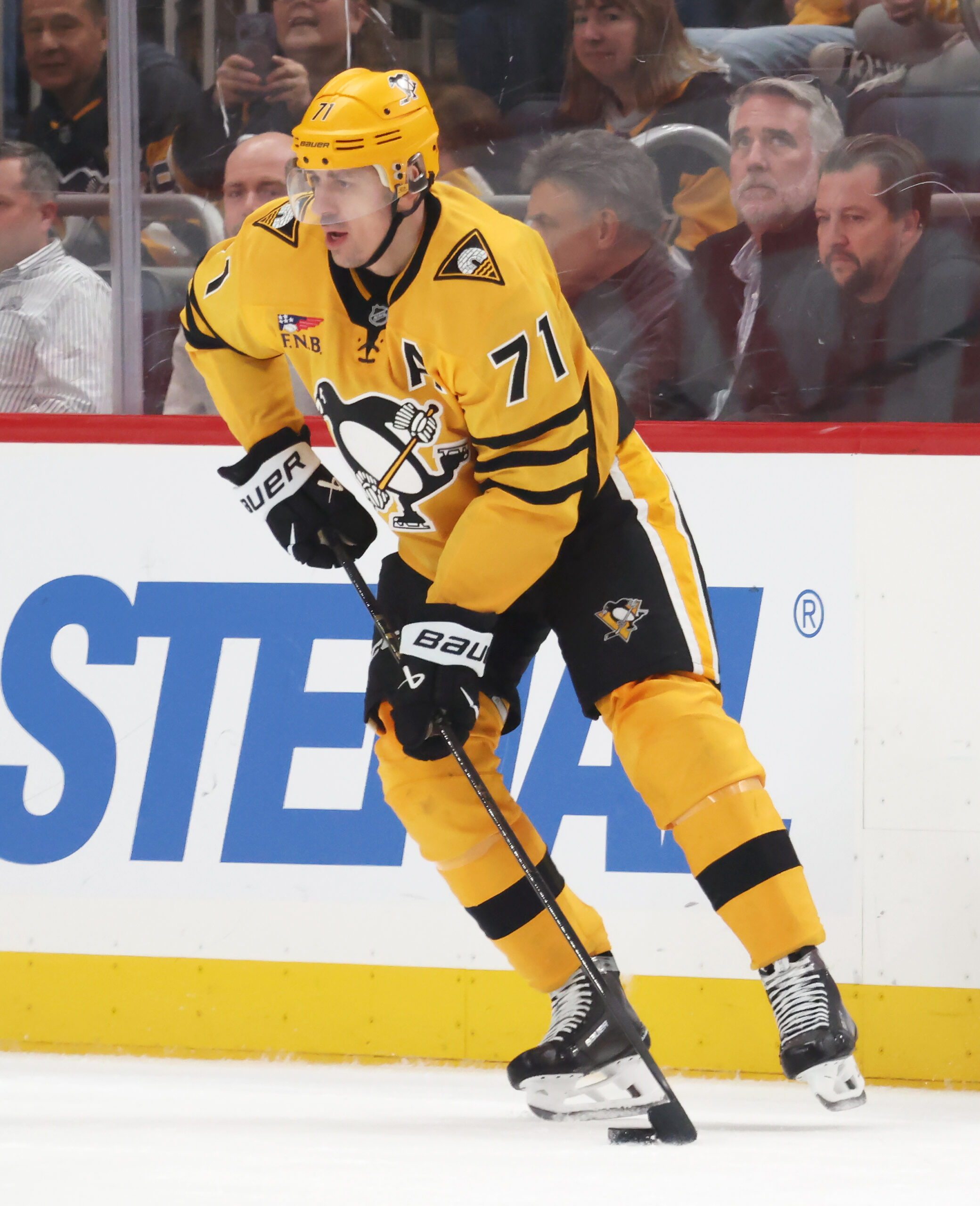
Malkin’s extension puts an end to what was months of speculation about his Penguins future.
Just this morning, we covered reports indicating that Malkin’s sights were set on an extension with Pittsburgh, and that he was unlikely to be headed elsewhere. This represented a distinct shift from what had been reported over the last year.
A year ago, Josh Yohe of The Athletic reported that the 2025-26 season would be Malkin’s “last in Pittsburgh.” He cited sources within the organization who indicated that the Penguins were “not expected to offer him another contract with the franchise.”
It seems Malkin’s performance this past year, as well as the Penguins’ surprisingly strong regular season, changed the organization’s thinking.
Malkin, who turns 40 at the end of July, seemed to turn back the clock in 2025-26. He scored 19 goals and 61 points in 56 games, his first season pacing at above a point-per-game rate since 2022-23. The Penguins endured a difficult series against their arch-rival Philadelphia Flyers, losing in six games in the first round, but that doesn’t erase what he was able to accomplish in the regular season.
The key question for Malkin is health. While he was perfectly healthy in 2022-23 and 2023-24, he has missed some time in each of the last two years. In 2024-25, he played in 68 games, and this past year was limited by upper-body injuries as well as a lengthy five-game suspension. Malkin’s on-ice qualities remain exceptional, but there has been concern about his ability to stay on the ice, as well as how his on-ice value will fare if the pace of his game slows further.
Pittsburgh appears determined to turn over their team to a new generation of young forwards, including promising rookie center Ben Kindel. Much of the prior reporting indicating Pittsburgh was hesitant to extend Malkin can likely be explained by the organization’s desire to carve out as much ice time and prime power play opportunities for its young forwards.
But Malkin showed he still has quite a lot to offer in the NHL, and the Penguins don’t have to pick between keeping Malkin and developing their young players – they can do both. Kindel, for example, could stand to benefit from another season sharing the ice and locker room with Malkin.
Now, he’ll get the chance to do so as the Penguins have elected to keep one of their two legendary centers for an additional season.
Photos courtesy of Charles LeClaire-Imagn Images