
Prospect Notes: Bakke Olsen, Masse, Lacelle
Norwegian forward Eskild Bakke Olsen is catching NHL attention at the 2026 World Championship. He has begun to garner interest from NHL clubs, Daily Faceoff’s Steven Ellis told Norwegian news outlet Nitten. Bakke Olsen is currently tied for second on Team Norway in tournament scoring with five points in seven games. He signed a three-year contract with the SHL’s Linkoping HC ahead of the 2025-26 season. That will mean any NHL move prior to 2028 will require a buyout.
Bakke Olsen, 24, grew up through Norway’s youth hockey ranks and debuted in the country’s top pro league in 2020. He moved to Sweden’s HockeyAllsvenskan three years later and quickly stood out. He led BIK Karlskoga in scoring with 37 points in 49 games of the 2023-24 season, then held onto his title with 53 points in 48 games of the 2024-25 season. Those performances earned Bakke Olsen a promotion to the SHL last season. He made good work of it, with 32 points in 51 games of his first season with Linkoping – the second-most scoring on the team.
The playmaking center will try to continue his climb up the hockey world with another strong SHL season, or a move to North American pros, on the other side of the World Championship.
Other notes from around the hockey world:
- The University of Massachusetts has confirmed the addition of Anaheim Ducks prospect Maxim Masse. The reigning QMJHL scoring champion will be one of college hockey’s top recruits after notching 51 goals and 102 points in 63 games of the Chicoutimi Sagueneens season. At 6-foot-3, 200-pounds, Masse brings a rare mix of size and scoring ability. He has grown to top prospect status since his third-round selection in the 2024 NHL Draft and should continue to demand a top lineup role with the MinuteMen. But already 20 years old, Masse will also face questions of if he can turn pro before his fast-moving development begins to slow down.
- 2026 NHL Draft goalie prospect William Lacelle has decided to continue his career at the University of Nebraska-Omaha next season. He will help the Mavericks make up for the graduation of captain Simon Latkoczy following his move to the ECHL. Lacelle is garnering mid-round attention after splitting his season between the Rimouski Oceanic and Baliville-Boisbriand Armada. He finished the year with a .917 save percentage and 27-15-2 record between the two squads. Lacelle added a .909 save percentage and 10-5-0 record in 15 playoff games with the Armada. He will compete with Omaha’s 2025-26 backup Dawson Cowan for starting minutes next season. Cowan recorded a .901 save percentage and four wins in 12 starts this season.
Four-Time Cup Winner Claude Lemieux Passes Away At Age 60
New Jersey Devils cult star and four-time Stanley Cup-winner Claude Lemieux has passed away at the age of 60. Lemieux played through 21 seasons and 1,215 games in the NHL between 1983 and 2009. He was a true pest, filling a unique and impactful lineup role through seven years with the Montreal Canadiens, six with the Devils, five with the Colorado Avalanche, three with the Phoenix Coyotes, and one each with the Dallas Stars and San Jose Sharks.
Lemieux’s hockey career began in the QMJHL. He racked up 66 points and 213 penalty minutes in the 1982-83 QMJHL season, immediately establishing his place as a forward adamant about making the scoresheet in one way or another. Montreal drafted Lemieux in the second-round of the 1983 NHL Draft and returned him to the junior league for the next two seasons. He finished his QMJHL career with a staggering 210 points and 379 PIMs in 103 games before turning pro full-time in 1985.
Lemieux spent his first pro season in the AHL. He finished the year with 53 points and 145 PIMs in 58 games – then stepped up as an X-factor addition to Montreal’s run to the 1986 Stanley Cup. Lemieux recorded three points and 31 PIMs in five games of the 1986 Stanley Cup Finals, helping the Canadiens seal a 4-1 series win over the Calgary Flames. The gritty winger would go on to net 53 points in his NHL rookie season in 1986-87 and would continue to pace for 50-to-60 points on Montreal’s second-line role through the 1989-90 season.
Montreal sought a bit more well-roundedness in the 1990 summer, leading the Canadiens to trading their gritty winger to the Devils in exchange for playmaker Sylvain Turgeon. That move kicked off the heart of Lemieux’s career, as he joined a loaded New Jersey offense already featuring Brendan Shanahan, Peter Stastny, Kirk Muller, and John MacLean. Lemieux scored 47 points in 78 games of his first season in New Jersey.
That dip below 50 points was quickly forgotten when Lemieux led the team in scoring with 68 points of their transformative 1991-92 season. Through major roster turnover, including the emergence of Scott Stevens and Martin Brodeur, it was Lemieux’s all-out energy and work ethic that held the Devils together. He willed the team to the 1992 postseason to extend what was, then, a six-year streak of playoff appearances for the winger. He topped the lineup again with a career-high 81 points in 1992-93, while continuing to pace for 150 PIMs every season.
The 1993-94 season brought some relief to Lemieux’s lineup-leading responsibilities. He scored just 44 points and 84 PIMs in 79 games that season – but seemed to be conserving his energy all year long, and spent that reserve on a tremendous 1994 playoff run. Always a playoff star, Lemieux raced to 18 points and 44 PIMs in 20 games of the ‘94 postseason as New Jersey pushed to the Eastern Conference Finals.
They would lose that series to the New York Rangers – but Lemieux repeated his performance in 1995, with a quiet regular season followed by a loud playoffs. He recorded 13 goals, 16 points, and a tame 20 PIMs in 20 playoff games as New Jersey breezed to the 1995 Stanley Cup. While the lineup was full of superstars – including the legendary defense pairing of Stevens and Scott Niedermayer and starting goaltender Brodeur – it was again Lemieux’s nasty edge that brought the Devils life. His ability to play a chippy, relentless style proved exhausting for opponents and led to multiple goals scored from seemingly inside of the opposing crease. His ability to tie everything together landed Lemieux the 1995 Conn Smythe trophy – the only individual award he would win in his expansive career.
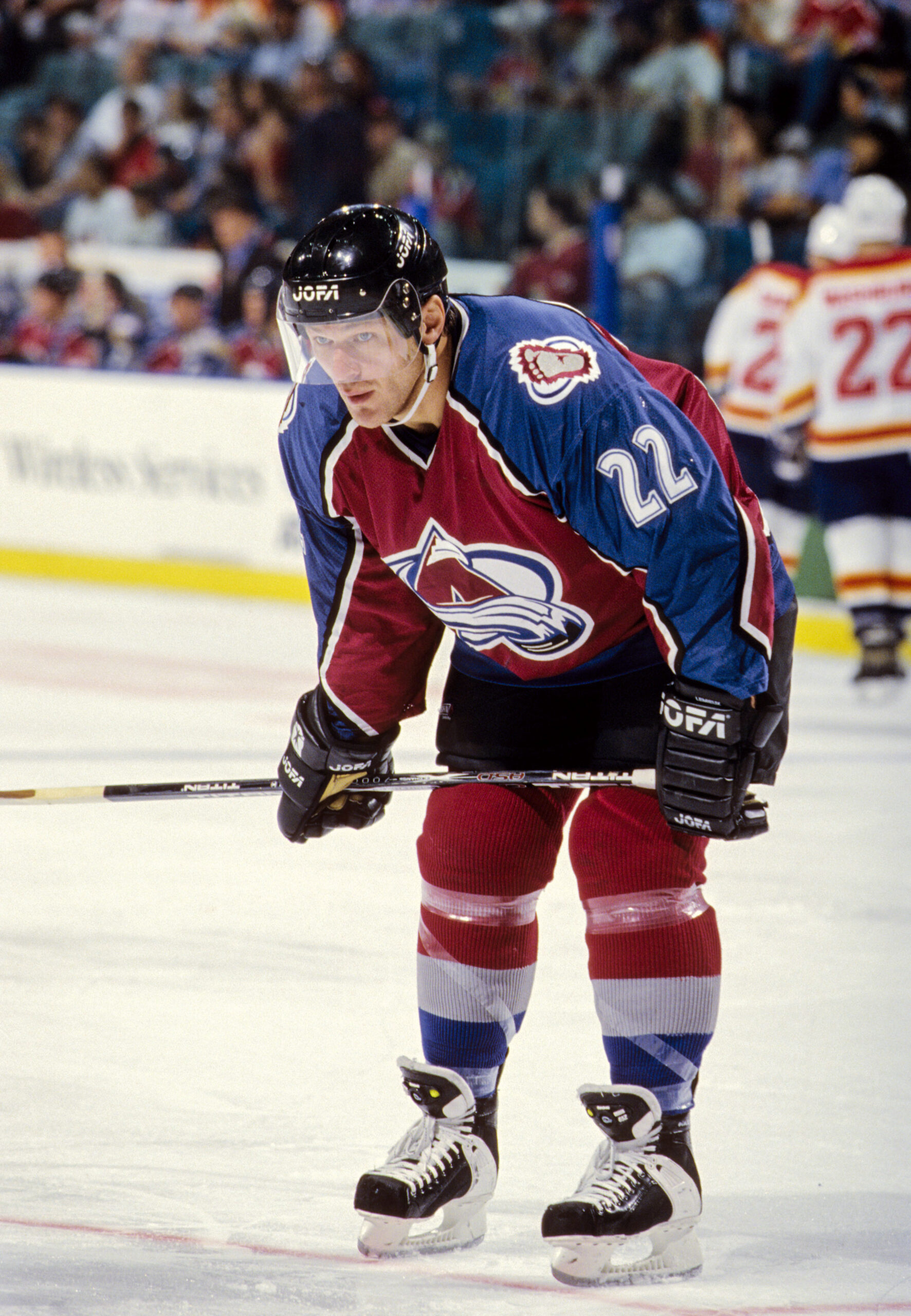 The Devils, surprisingly, traded Lemieux to the Colorado Avalanche ahead of the 1995-96 season. He was again swapped in a one-for-one deal, this time returning Wendel Clark to the Devils. Lemieux was in a familiar situation, joining a strong Avalanche lineup that included Joe Sakic, Peter Forsberg, and Patrick Roy. He was the final addition in Colorado’s top-six and reached a lofty 39 goals and 71 points in 79 games of the regular season. Lemieux kept it rolling with 12 points and 55 PIMs in the 1996 Stanley Cup playoffs, once again proving to be the X-factor behind a loaded offense en route to his third Stanley Cup win and second consecutive win.
It was in the 1996 postseason that Lemieux delivered one of his most notorious hits. He hit Detroit Red Wings star Kris Draper into the boards, resulting in Draper sustaining a concussion, broken jaw, broken nose, and broken cheekbone. The injuries required reconstructive surgery that forced Draper to have his jaw temporarily wired shut. The hit cemented Lemieux’s status as a cheap-shotting grinder and would lead to a prolonged rivalry between the Avalanche and Red Wings.
Lemieux continued to perform at a top level and help ensure runs to the playoffs through Colorado’s next three seasons. He was traded back to the Devils in 2000 in a colossal exchange that sent Brian Rolston back to the Avalanche. Lemieux didn’t miss a beat in one year back in New Jersey, notably notching 10 points and 28 PIMs in 23 games of the 2000 Stanley Cup playoffs as he supported a fourth Stanley Cup win.
Lemieux moved to the Phoenix Coyotes after winning another Cup with the Devils. He was an early great in the Coyotes franchise but the move would bring an end to Lemieux’s 15 consecutive postseason berths in 2001. He willed the Coyotes back to the postseason in 2002, all while notching diminishing offense and penalty totals on a roster still trying to find its core. The Coyotes flipped Lemieux to the Dallas Stars in January 2003. After another down year, he opted to step away from the NHL for the 2003-04 season, moving to Switzerland’s National League for one season before announcing his retirement in 2004.
Retirement did not keep Lemieux out of the spotlight. He assumed the president role for the ECHL’s Phoenix RoadRunners from 2005 to 2007 and was frequently featured in TV and media. After stepping down from his front office role in the ECHL, Lemieux built up towards a return in the 2008-09 season. At the age of 43, Lemieux began the year with the China Sharks of the Asia League, then signed a contract with the AHL’s Worcester Sharks in November. That led to a two-way contract with San Jose in December and a call-up to the NHL in January. Lemieux would score one point in 18 games with San Jose as the Sharks chased the President’s Trophy as the league’s top team.
Lemieux stayed a prominent hockey figure well after his second retirement in 2009. He was most recently a torch-bearer in one of Montreal’s pre-game ceremonies during the 2026 Eastern Conference Final. It was his final public appearance. Lemieux will be remembered as one of the greatest NHL players to hate among many fans. He was a tenacious, relentless, and aggressive winger who seemed to constantly deliver devastating blows – whether it was timely goals or injury-inducing hits. Pro Hockey Rumors sends our condolences to Lemieux’s family, friends, and countless fans.
Photo courtesy of RVR Photos-Imagn Images.
Sharks Sign Phillip Sinn To Entry-Level Contract
The San Jose Sharks have looked towards Germany to reinforce their blue line. Defenseman Phillip Sinn has signed a two-year, entry-level contract with the Sharks set to begin next season. Sinn spent last season with EHC Munchen of Germany’s DEL and played five games with Team Germany at the 2026 World Championships. Reports of NHL interest around Sinn was first reported by German hockey news source Eisblog.
Sinn, 22, is a true shutdown-defenseman. He scored just nine points across all levels of competition in the 2025-26 season, including three points in 35 games of his DEL season. Despite those low marks, Sinn stood out with a long reach and physical style that helped secure an otherwise offensively-leaning defense corps – led by former Carolina Hurricanes defender Ryan Murphy. Sinn was most productive in a seven-game assignment to Germany’s minor-pro league, where he recorded four assists.
The 6-foot-2 defender rose through the ranks of Austrian hockey and made his debut in the country’s top league in 2023. He finished his first pro season with seven points in 30 games with EC Salzburg and captained Team Germany at the 2024 World Junior Championships – where he scored four points in five games. Sinn has since built a tendency for very little scoring in top pro leagues, but near point-per-game scoring in minor-pro leagues, through trips in Austria and Germany. Those tenures include no scoring in 12 games in the Champions Hockey League, but two points in three games of Germany’s Deutschland Cup.
Sinn will bring another big body and shutdown ability to the Sharks defense corps. He could have a hope at one day filling the hard-working, shutdown role filled by Mario Ferraro in his final months in the Sharks lineup. That dream will be far off, though, as Sinn enters his North American career behind prospect Leo Sahlin Wallenius on the depth chart and almost certainly headed for a second-pair role in the AHL.
Latest On Golden Knights, Bruce Cassidy
May 28th: Vegas does not plan to grant teams permission to talk with Cassidy until the end of their run in the 2026 Stanley Cup Playoffs per ESPN’s Emily Kaplan. Cassidy is believed to have mutual interest with the Oilers and has also fielded interest from the Kings. Kaplan adds that Edmonton could pivot to John Tortorella should Vegas be willing to part with the coach who has led them to the Stanley Cup Finals. The Golden Knights had originally planned to move on from Tortorella and promote Ryan Craig, head coach of the AHL’s Henderson Silver Knights, but their recent postseason success has complicated that plan. Edmonton will follow that plan very closely as they look to bring in a veteran head coach to replace Kris Knoblauch.
May 19th: The NHL Coaches’ Association (NHLCA) is posturing to involve itself in the repeated instances of the Golden Knights blocking Cassidy from interviewing with the Kings and Oilers. According to a public announcement, the NHLCA said:
“The NHLCA has been closely monitoring the situation involving Bruce Cassidy. While we respect the League’s rules and processes, it is our position that coaches who remain under contract, but are no longer working for their Club, should not be prevented from pursuing other employment opportunities. It would be unprecedented at the head coaching level should multiple teams be denied permission to speak with Coach Cassidy. The situation is still unfolding, but our priority is to protect the interests of our members in this type of circumstance.“
Although their frustration is understandable, it’s unclear what the NHLCA would do to assist Cassidy. As was previously noted, coaches are often “relieved of duties” rather than “fired”, making them still subject to the obligations outlined in their contract.
May 18th: Despite firing him with eight games remaining in the regular season, the Vegas Golden Knights are playing hardball with Bruce Cassidy‘s future. Earlier today, TSN’s Pierre LeBrun reported that the Golden Knights haven’t given any team permission to interview Cassidy for head coaching vacancies.
Additionally, Andy Strickland of FanDuel Sports Network went a step further, indicating that the Golden Knights blocked the Los Angeles Kings from interviewing the former Jack Adams Award winner. However, that hasn’t been confirmed elsewhere. Still, it wouldn’t be surprising if they did, if they haven’t already, given that Vegas blocked the Edmonton Oilers from interviewing their former head coach just a few days ago.
Unless another head coach is fired in the next few weeks, that leaves the Toronto Maple Leafs as the only option left for Cassidy. However, on Friday’s rendition of 32 Thoughts, Sportsnet’s Elliotte Friedman said, “I do think they’ll reach out to talk to Cassidy, but I’d say it’s extremely unlikely he’s gonna end up being the guy in Toronto, and I do think they are prepared to go fresh. Someone new, someone different.”
As unfair as it seems to Cassidy, those are the rules of the coach’s contractual obligations. Although it’s essentially a firing, coaches are often “relieved of duties”, rather than outright fired. This means they are still bound by the contract they signed and continue to receive payment from the team that released them. So, until Cassidy’s contract with the Golden Knights formally ends, any team wishing to interview him will have to put in a formal request.
There remains plenty of speculation regarding the Kings and Maple Leafs, but it does seem the Oilers have moved on from their pursuit of Cassidy. Earlier today, it was confirmed that Edmonton received permission from Toronto to interview Craig Berube, and he appears to be the early favorite for the role.
Ultimately, if Vegas is going to continue to block their intradivisional rivals from hiring Cassidy, he’ll have to wait for another shoe to drop for his next landing spot. Although it’s hardly appropriate to speculate on someone losing their job, Andrew Brunette of the Nashville Predators and Sheldon Keefe of the New Jersey Devils may be looking for new roles this summer, given that each team will be under new management in the front office.
Belarus Reinstated For IIHF Tournaments
The International Ice Hockey Federation (IIHF) has announced that Belarus will be reinstated for competition beginning next season per Steven Ellis of Daily Faceoff. The announcement came during the organization’s annual congress held in Zurich, Switzerland this week. Belarus has been barred from international competition since 2021 due to their involvement in Russia’s invasion of Ukraine. In a statement, the IIHF said:
This decision was not taken lightly. The safety and well-being of players, officials, fans, volunteers, and all participants remains our highest priority. Based on the assessments conducted and ongoing consultations with relevant stakeholders, we believe this can be done in a safe, responsible, and controlled manner.
No update was provided on Russia’s eligibility for IIHF tournaments. In a statement, the Russian Hockey Federation acknowledged their partnership with the IIHF to work back towards tournament eligibility while also noting that their ban remains in place.
Belarus’ last participation in an IIHF tournament was at the 2022 World Junior Championship Division-1A tournament. They won the tournament with a 5-0-0 record and 26-to-eight goal differential. Their roster was laden with NHL talent. Top draft pick Artyom Levshunov led a group that also featured forwards Vitali Pinchuk and Yegor Sidorov, defensemen Dmitri Kuzmin and Daniil Karpovich, and goaltender Aleksei Kolosov. Belarus was suspended from IIHF competition following this tournament and Latvia – the Silver Medal winners – were promoted in their place.
Belarus appears set to join the top division of the World U18 Championship, but the second division of the World Championship, ahead of the IIHF’s 2027 tournaments. The country will bring a high-powered roster to the men’s tournament, while also boasting a chance to showcase their top draft-eligible prospects next season.
Canada Registers Sam Dickinson, Jack Ivankovic At World Championship
Team Canada will finish off the World Championship with the help of two top prospects. San Jose Sharks defenseman Sam Dickinson and Nashville Predators goalie prospect Jack Ivankovic have been registered for the remainder of the tournament per Steven Ellis of Daily Faceoff. Neither player is expected to suit up for Thursday’s quarterfinal matchup against Team USA, which could be Canada’s last of the tournament.
Both Dickinson and Ivankovic have been with the Canadian side through the extent of the World Championships – but are only now lineup-eligible, after being registered. Circumstance may keep the duo from debuting with Canada’s men’s team but the chance to spend time with NHL greats like Sidney Crosby, Evan Bouchard, and Ryan O’Reilly will nonetheless be invaluable.
Dickinson wrapped up his rookie season in the NHL with quiet totals. After notching historic scoring during his three-year career in the OHL, the puck-moving defender only scored one goal and 14 points in the first 72 NHL games of his career. He struggled to bring his dominant offense to the pro flight – but still showed flashes of the heads-up playmaking that earned him 91 points in 55 OHL games just last season. Dickinson will be leaned on as a core, offensive-defenseman behind San Jose’s young forwards for years to come. The chance to join his future-captain, Macklin Celebrini, at the 2026 World Championships will be another chance to find his comfort at the top level.
Ivankovic played through his freshman season at the University of Michigan after being drafted in the 2025 second round. He was called upon right away by the Wolverines and quickly stood out as one of the team’s biggest difference-makers. Ivankovic stuck around a .920 save percentage for much of the year, until his season was derailed by a scary-looking, lower-body injury sustained in a January matchup against rival Notre Dame. The injury was believed to be long-term – but Ivankovic was only out of the lineup for one month before returning to full-time, starting duties. He finished the year with a .921 save percentage and 25-8-1 record while backstopping the school that spent much of the year ranked #1. He also followed an NHL teammate – O’Reilly – to this tournament but lost his chances to start thanks to Jet Greaves‘ .926 save percentage through five wins.
While both prospects may continue to watch the tournament from the press box, their addition to the roster will stand as a bode of confidence from Hockey Canada. Both players will almost certainly be major parts of Canada’s World Championship, and other international, rosters in the years to come.
Corey Perry Intends To Continue Playing Career
Recently turned 41-year-old Corey Perry is looking to extend his career into a 22nd season, confirmed by Pierre LeBrun of The Athletic earlier today.
Playing in unusual colors back in 2019 as a Dallas Star at age 34, it already looked like Perry hardly had much left in the tank, with just five goals in 57 regular season games. Nobody back then would have expected that the 6’3” winger would be a notable member of the 2026 free agent class, but sure enough, it looks like that’ll be the case.
By now everyone knows about Perry’s five losses in the Stanley Cup Final, but the power forward impressively keeps humming along, notching 17 goals in 72 games this season, six of them in just 22 games after being traded back to the Lightning at the deadline. Fetching his short-term club in Los Angeles a 2028 second-round pick, it goes to show how high Perry remains valued today.
Lebrun speculates that a return to the Bolts won’t be happening, and assuming Perry is picked up by a hypothetical eighth club (barring a return to any of his previous seven) he’d have major milestones in store. The Ontario native needs just 36 regular season appearances to become the 26th player in league history to reach 1,500 games. Only Alex Ovechkin and Brent Burns are in that club as fellow active players.
As long as Tampa Bay can be crossed off the list, Perry should have several other suitors to choose from on July 1. A deal right in line with last summer’s one year, $2MM contract, that one offered by the Kings, would be in order. With practically an entire portfolio of recent one year contracts to draw upon as examples, the possibility also exists of one like his 2023 agreement with Chicago, a higher rate to join a younger squad, with the idea of later choosing his favored destination at the trade deadline. Of course, at this point it’s not so much about the money as it is about the fit, ideally one which would lead Perry to his ever-elusive second Stanley Cup ring one way or another.
While the veteran was making the rounds on various teams and going on deep playoff runs, his original club in Anaheim built a formidable roster which is ready to contend. A Ducks return would be a storybook ending for Perry, who broke into the NHL in 2005 as a “Mighty Duck”, donning the eggplant alongside franchise legends Teemu Selänne and Scott Niedermayer. Back to the present day, it’s worth mentioning that their forward corps already feature Alex Killorn and Chris Kreider as aging veterans offering similar on-ice traits to Perry. Still, the 2011 Hart Trophy winner would be a great model for 20-year-old Beckett Sennecke.
Tack on Perry’s 244 playoff games to his total resume, and it has been an incredible career for the 28th overall selection in 2003. Somewhat hard to believe, just he and Burns are the only remaining active players from the draft 23 years ago which has gone down as arguably the best in NHL history. At least for one more year, its impact will continue to be felt, all while more rising young stars emerge who were born years after Perry’s name was called at the draft.
Can The Sabres Afford To Retain Alex Tuch?
The Buffalo Sabres broke a 14-year playoff drought this season in spectacular fashion and were within a shot of reaching the Eastern Conference Finals when Alex Newhook of the Montreal Canadiens broke their hearts in overtime. That one shot has no doubt haunted Sabres fans since the loss, and it was a frustrating defeat for a team whose top players went cold when the team needed them most. One of those players was forward Alex Tuch, who failed to score in the second round, when Montreal’s margin of victory was about as small as it could be. Despite Tuch’s lack of production, the pending UFA isn’t likely to see his stock fall too far as he approaches the open market on July 1, and that is a problem for the Sabres, who are facing a cap crunch and may not have the room to keep Tuch and his potential $10MM-$11MM cap hit.
Tuch is an interesting player, as he was the centerpiece of the return for Jack Eichel when the Sabres shipped him out to the Vegas Golden Knights. He is also a local, hailing from Syracuse, New York, and he has been one of the best deals in the NHL, collecting just $4.75MM annually while putting up 139 goals and 170 assists in 360 games as a member of the Sabres. It’s been a mutually beneficial relationship thus far, but it’s hard to say whether that will continue, especially if Tuch’s play starts to fall off in his 30s while he’s making north of $10MM annually.
According to PuckPedia, the Sabres currently have just shy of $12MM in available cap space with 22 players signed. At first glance, it seems straightforward that they could fit Tuch under the cap, but that’s where the problems start to emerge. Aside from Tuch being unsigned, the other two unsigned forwards are Zach Benson and Peyton Krebs, both of whom are due for large raises. Using AFP Analytics projections, Benson would be looking at a short-term deal around $4.2MM per season, while Krebs should fall in the $3.5MM range. That’s a $7.7MM expenditure if the Sabres go short-term on Benson, but if they go long-term, it might be closer to $7MM annually just for Benson. Couple those numbers with a potential $10MM cap hit for Tuch, and the Sabres would blow past the salary cap pretty quickly. That is without factoring in defenseman Michael Kesselring’s contract, which will also likely top $4MM annually. Nor does it consider the future contracts that will need to be signed with Noah Ostlund, Jiri Kulich and Konsta Helenius.
The Sabres have substantial maneuvering to do if they want to welcome Tuch back into the fold. But do they want to trade away foundational young players just to accommodate a veteran forward on the wrong side of 30 whose best days will soon be behind him? It’s a potential $70MM-$80MM question the Sabres will need to answer, and one that could dictate how the next 5-10 years play out in Buffalo.
The Sabres have to consider Bowen Byram’s future as well, since he is just 13 months away from becoming a UFA and will command a healthy payday on his next deal. But even moving the 24-year-old likely wouldn’t get the Sabres back under the cap if they sign Tuch and the other aforementioned players, meaning moving Byram alone would be the first of multiple moves. The Sabres already have Rasmus Dahlin and Owen Power on the left side of their defense and may not need to keep Byram in the fold. So far, reports say Byram likes Buffalo, and they plan to meet this summer to discuss an extension.
So, what can the Sabres do to retain the talent they want to keep and stay under the salary cap? Probably the easiest move in the short term is to trade forward Jason Zucker and his $4.75MM cap hit. Zucker has been a good pro for a long time, but with one year left on his deal and a limited no-trade clause, he is a straightforward move to stockpile a future asset and clear part of the books. But he can’t be the only move Buffalo makes to shed salary, and the move beyond Zucker will likely need to be a hard one, sending away an important player. That’s not to minimize Zucker’s contributions, as he is one of the few veterans on the Sabres, but at 34 years old, he doesn’t have many years left in the NHL, and Buffalo might have to trade a younger asset to clear space if they want to sign Tuch.
That brings us back to the question at the outset of the article: Can the Sabres afford to keep Tuch? On paper, it’s possible. With cap maneuvering, such as trading Zucker and Byram, it’s very possible. But for the long-term health of the Sabres, they might need to let Tuch walk and be happy that he had a run in Buffalo that ended with them snapping a long playoff drought. Players rarely get better in their 30s, and it’s a guessing game when the decline begins. The NHL is littered with cautionary tales of teams signing players in their 30s to expensive contracts in unrestricted free agency, and the Sabres would be wise to sit out the Tuch negotiations and let another NHL club sign a contract that could one day end in a buyout.
Sharks Sign Jimmy Huntington To One-Year Extension
The San Jose Sharks shared earlier today that forward Jimmy Huntington has been re-signed on a one-year, two-way contract. Financial terms have not yet been reported, but as a two-way pact it automatically carries at least a league minimum $850k at the NHL level.
A veteran of the AHL, the 27-year-old joined the San Jose Barracuda this past season and put together his best campaign yet, recording 48 points in 71 games. The center was third in team scoring, producing alongside several skilled youngsters such as Filip Bystedt and Quentin Musty.
Undrafted out of the QMJHL, Huntington feasted alongside Alexis Lafrenière with the Rimouski Oceanic in 2018-19. Catching on with the Lightning organization after a 92-point season, he went on to make a two-year stop with the Milwaukee Admirals. The Laval, Quebec native moved on to the Hershey Bears for 2023-24, helping lead the Capitals affiliates to a Calder Cup title, with 14 points in 20 games during the run.
Since finding himself out west, Huntington’s efforts this season in San Jose helped the Barracuda rank 13th in the AHL, although they were sent home by the Henderson Silver Knights in the opening round. Still seeking his NHL debut, the 6’0″ lefty will aim to build off a strong season, continuing to bring a well-rounded two-way game to the Sharks organization.
Evening Notes: Woodcroft, Lee, Jenner
The Toronto Maple Leafs are expected to interview Jay Woodcroft for their head coaching position, reported by Frank Seravalli of Daily Faceoff. He added that Woodcroft spoke with the Kings last week as well, and based on such interest, the 49-year-old looks well on track to be back in charge of an NHL bench in 2026-27.
Depending on how things go with the Leafs or Kings from here, it’s thought that Woodcroft is among the top candidates for the club in Toronto’s search. A native of the city, he started as a video coach with the prime 2000s Red Wings, winning a Stanley Cup in that role before moving on to San Jose as an assistant on Todd McLellan’s staff, also following him along to Edmonton afterward. Six years later he found himself leading the Oilers. Let go after a rough start to the 2023-24 campaign, Woodcroft served as an assistant with Anaheim this season, a part of their resurrection.
A modern mind with keen emphasis on analytics in a fast-paced offensive attack, Woodcroft has a career record of 79-41-13, all with Edmonton. He’s exactly .500 across 28 playoff games.
Elsewhere across the league:
- New York Islanders captain Anders Lee wants to add to his 14 seasons with the franchise as he approaches free agency. Still, general manager Mathieu Darche is motivated to open up cap space to more comfortably fit the contract in, as written by Stefen Rosner of The Hockey News. It’s not difficult to single out trade candidates, as Anthony Duclair was shopped around during trade deadline season with clearing his $3.5MM cap hit a priority. The winger who has struggled in New York has a full no-trade clause, making the situation more difficult to navigate. Pierre Engvall is next in line, his $3MM AAV running through 2029-30, but already having cleared waivers in the past, it’s obvious Darche would have to add enhancements to shed salary. The 29-year-old carries a high cost to be effectively a fourth liner at this point. Back to Lee, the veteran who turns 36 in July is no longer a top scorer, but he’s tremendously durable, missing just one regular season game in the past four years. As long as that pace continues through next year, he’ll reach the 1,000 game mark. AFP Analytics projects that Lee is due for a three year extension worth $6.60MM per season, not far from his current $7 million annual salary.
- Previously reported as possibly being squeezed out, Blue Jackets captain Boone Jenner’s future remains up in the air at this point, as outlined by Pierre Lebrun of The Athletic. The Columbus captain, whose 808 regular season appearances mark the longest tenured player on the team, was far apart on term in the first round of discussions as he seeks stability at age 32. Teammate Charlie Coyle, 34 no less, was given six years on his contract extension, so it’s curious to know what general manager Don Waddell has in mind with Jenner. Lebrun referenced his tendency to sometimes let negotiations run to the finish line, and with more than a month away from the open market, there’s plenty of time to work something out.