
Latest On Vladimir Tarasenko, Minnesota Wild
Although the Minnesota Wild “certainly liked” having Vladimir Tarasenko on their roster this past season, it’s questionable whether the club will end up being able to sign him to a contract extension, Joe Smith of The Athletic reported today.
According to Smith, “the price would have to be right” for the Wild to sign Tarasenko to an extension, meaning below the $4.75MM cap hit on his previous deal. After a bounce-back season that saw him produce 23 goals and 47 points on a strong Wild team, Tarasenko may feel he will be able to earn more on the open market than Minnesota is prepared to offer him.
Smith also noted one key factor complicating negotiations between the Wild and Tarasenko: agents. Tarasenko is reportedly repped by both Pat Brisson of CAA and Paul Theofanous of TMI, part of a formal collaboration agreement by Theofanous and CAA signed in February. Smith reported that Theofanous “is taking the lead with Tarasenko’s next deal.”
That could make it harder to reach a deal with Minnesota, as Theofanous is the agent who represents the Wild’s franchise player, Kirill Kaprizov. According to Smith, the Wild got “squeezed into” the $17MM AAV mega-extension they signed with Kaprizov, and it’s Smith’s belief that the Wild are “unlikely [to] play ball” with Theofanous again this summer.
The Wild have numerous pending unrestricted free agents to consider signing, including Mats Zuccarello, Michael McCarron, Marcus Johansson, and Nick Foligno. The Wild may not have the cap room to retain everybody, and may prefer to sign a player like Johansson to an extension rather than Tarasenko. Johansson, 35, scored 15 goals and 49 points this past season and is repped by J.P. Barry of CAA. AFP Analytics projects Johansson’s next deal at one-year, $3.2MM and Tarasenko’s at one-year, $3.4MM.
Although the Wild appreciated Tarasenko’s efforts in his year with the team, especially his proactive work to help rookie Danila Yurov adjust to life in North America, Tarasenko will likely be able to receive more substantial offers on the open market than what Minnesota will likely be prepared to offer. Tarasenko himself said he “would love to return” to the Wild, but such a return may not be in the cards for a variety of reasons.
Beyond just the recent history between Tarasenko’s lead representative and the Wild’s front office, the state of upcoming free agency could simply be too favorable for Tarasenko to pass up on a chance to test the open market. Free agency is widely expected to be thin on talent, with few difference-making scorers set to be available.
While Tarasenko hasn’t produced at above a middle-six rate for two years, he does have exceptional pedigree as a former star scorer and a two-time Stanley Cup champion. With many teams set to have significant cap space available, and precious little high-end free agent talent on the market to spend it on, the conditions are optimal for Tarasenko to enter the open market and receive a (relatively) substantial contract.
For as much as the Wild appreciated having Tarasenko on their team, it’s unlikely they will be able to match the kind of contract he could receive in free agency. The team is expected to be aggressive this summer in procuring high-end talent to support their immediate efforts to win a Stanley Cup (while they still have franchise defenseman Quinn Hughes under contract) and will likely want to preserve as much cap space as possible for their chase for a No. 1 center. Among other factors, that could price Tarasenko out of the Twin Cities.
Photos courtesy of Nick Wosika-Imagn Images
Latest On Nico Sturm
- The Minnesota Wild may be forced to choose between veteran fourth-line centers Nico Sturm and Michael McCarron over the next month, write Joe Smith and Michael Russo of The Athletic. The Wild traded a second-round pick to acquire McCarron, a pending UFA, from the Nashville Predators. McCarron indicated in his end-of-season media availability that he will be seeking to maximize his financial security with his next contract. If the Wild decide to pay the market price for McCarron, they could be forced to move Sturm. The 31-year-old has one more year left on his deal at a $2MM cap hit.
Wild Hoping To Re-Sign Michael McCarron
The Minnesota Wild “badly want to re-sign” mid-season trade addition Michael McCarron, reports Michael Russo of The Athletic. McCarron is set to become an unrestricted free agent on July 1. Wild GM Bill Guerin spoke on McCarron’s status in his end-of-season media availability, saying “we have a ton of interest in bringing Mac back. We thought he was a really good fit.”
The interest in finding a way to an extension appears to be mutual. McCarron said in his own end-of-season media availability that he appreciated the faith Guerin and the Wild showed in him when they dealt a second-round pick to the Nashville Predators to add him at the trade deadline. 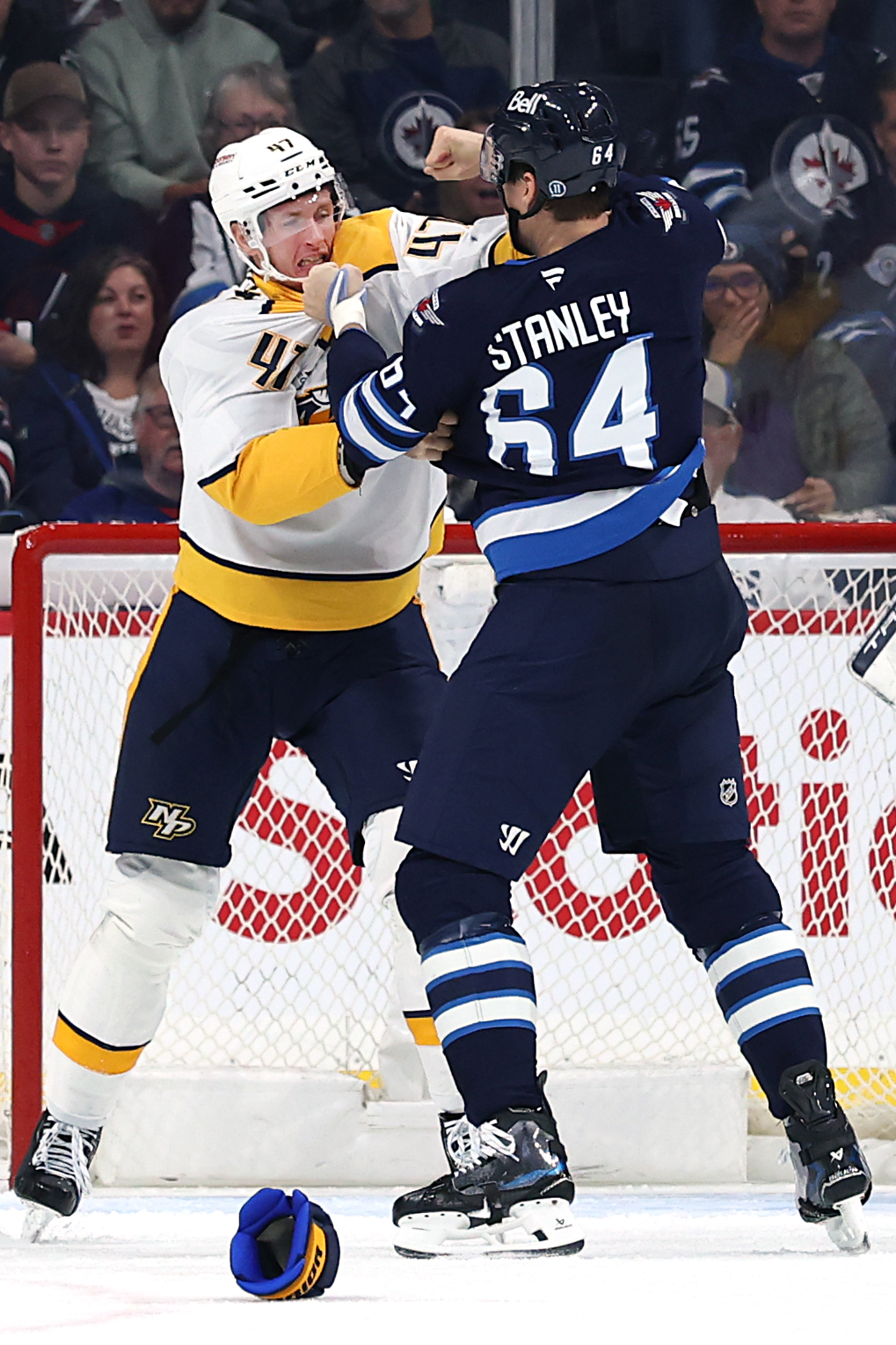
But he also added that he is “looking for” security in his next contract, calling himself someone who has yet to take “that next step financially” in his career thus far.
McCarron is lined up to potentially receive a life-changing contract as a free agent this summer. The 31-year-old’s most lucrative contract was one he signed with the Predators in 2024, and that contained a base salary of $900K.
AFP Analytics projects McCarron to receive a two-year, $2MM AAV contract this summer, but that could very well be an extremely conservative projection. Russo and colleague Joe Smith wrote a week ago that McCarron “may be able to get a $4 million or $5 million payday” given the scarcity of centers on the free agent market.
Offers at that kind of value would almost certainly price McCarron out of Minnesota. The cap hit of franchise forward Kirill Kaprizov is set to balloon from $9MM to $17MM this summer, and the Wild have several other pending free agents to re-sign, including Mats Zuccarello, Vladimir Tarasenko, Zach Bogosian, Marcus Johansson, Nick Foligno, and restricted free agent Bobby Brink. They also, of course, want to preserve as much cap space as possible to make further additions via trade or free agency. While the Wild appear eager to retain McCarron, and McCarron seems fully willing to commit to Minnesota, the money simply may not make sense for either side.
As a free agent, McCarron could be a coveted bottom-six center option. The Wade Arnott (Newport Sports Management) client brings coveted size to the position, standing 6’6″, 232 pounds. He showed himself to be capable as an NHL penalty-killer both with the Predators and with the Wild, and has long been an asset at the faceoff dot. McCarron won 52.5% of his draws in 2025-26 and had a 53.7% win rate during his time in Music City.
There are limitations to McCarron’s game, of course, and none is more pronounced than his offense. McCarron quite simply hasn’t been able to produce much offense at the professional level, save for a strong rookie campaign in the AHL and a solid 12-goal, 22-point season with the Predators in 2023-24. But McCarron plays the kind of role where teams aren’t going to be counting on him for offense, so it’s easy to see why he’d attract a lot of interest as a free agent center among teams looking to bolster their bottom-six.
Minnesota is going to be one of those teams, but it’s unclear at this time whether the finances are going to be right for either side.
Photos courtesy of James Carey Lauder-Imagn Images
Snapshots: Foligno, Legault, KHL
Minnesota Wild winger Marcus Foligno told The Athletic’s Joe Smith that it would be a “no-brainer” for his brother Nick Foligno to accept a contract extension with the Wild, assuming he is offered one. Foligno said his brother “showed he’s a great role piece for this team” and “likes the makeup of the team” moving forward. With that said, the elder Foligno brother, Nick, said he needs to discuss all of the possibilities for his playing future with his family, and that he will need to be “100 percent committed” if he’s to continue his career with the Wild.
Foligno, 38, was a solid contributor in Minnesota after they acquired him in a mid-season trade with the Chicago Blackhawks. Though he didn’t produce much offense (just four points in 17 regular-season games) he did hold his own on the penalty kill and as a physical presence in the bottom-six. Smith also noted that Foligno, a former captain for two NHL teams, became a “respected voice in the room” for the Wild. If he’s to return in Minnesota, Foligno would likely need to take a steep pay cut from the $4.5MM he earned on his last deal. When Foligno signed that contract, he was in the midst of a season that he finished with 17 goals and 37 points in 74 games. It’s unlikely Foligno will reach that level of scoring again, but he still has something to offer NHL teams, and his brother hopes he’ll do so in Minnesota.
Other notes from around the hockey world:
- The AHL announced today that Chicago Wolves defenseman Charles-Alexis Legault has been suspended one playoff game “as a consequence of a boarding incident” in his team’s playoff game against the Grand Rapids Griffins on May 19. A video of the play in question can be found here. Legault appeared to drive Griffins forward Amadeus Lombardi into the boards, after Lombardi had already tripped and was sliding on the ice. Grand Rapids ended up winning the game in overtime thanks to a goal from first-round pick Michael Brandsegg-Nygard, but the Wolves retain a 2-1 series advantage. They can end Grand Rapids’ season tonight in game four, but will have to do so without Legault.
- Lokomotiv Yaroslavl of the KHL won their second consecutive Gagarin Cup title earlier today, defeating Ak Bars Kazan in six games. Lokomotiv’s roster is full of players who are either NHL prospects or who were formerly members of NHL organizations. Their leading scorer, Alexander Radulov, was a lethal scoring winger for the Dallas Stars from 2017 to 2022. Winger Richard Pánik is a former NHL 20-goal scorer. The team also has a few NHL prospects, including 2020 Edmonton Oilers draft pick Maxim Berezkin, and Nashville Predators 2024 first-rounder Yegor Surin. Per Alex Daugherty of The Tennessean, Predators Assistant GM and Director of Scouting Jeff Kealty said Surin “would be an NHL player” right now if not for his contract with Lokomotiv, which runs through 2026-27.
Latest On Jesper Wallstedt, Wild Goaltending
The Minnesota Wild could be considering a shift in their crease.
After making the second round of the Stanley Cup Playoffs for the first time since the 2014-15 season, General Manager Bill Guerin is going to want to ensure he can elevate his team further beyond that threshold with the current core of players he has built. Among moves the Wild could make, Elliotte Friedman on the FAN Hockey Show said that he doesn’t think Minnesota is going to move off goaltender Jesper Wallstedt, and that Filip Gustavsson would be the netminder in consideration to trade. The discussion originated from an article in The Athletic, which reported that Minnesota had offered Wallstedt in a package deal for Blues center Robert Thomas at the 2026 NHL Trade Deadline.
The discussion originated from an article in The Athletic, which reported that Minnesota had offered Wallstedt in a package deal for Blues center Robert Thomas at the 2026 NHL Trade Deadline. Since opting to keep their 23-year old goaltender, Wallstedt split the workload down the stretch of the regular season, playing 10 games, as did Gustavsson. But Wallstedt earned his keep, tallying a .930 save percentage and a 1.98 goals against average to end the regular season. In the playoffs, Gustavsson saw one game to Wallstedt’s 10 in between the pipes, where the rookie goaltender averaged 29.9 saves throughout that stretch.
However, that workload didn’t come without reason. In Minnesota’s end-of-season press conference, it was announced that Gustavsson will undergo offseason hip surgery. Furthermore, the Wild are not sure if he’ll be able to play by the start of next season. This development brings complications to Minnesota and its approach to how it can progress in its offseason moves.
Gustavsson and Wallstedt took up only 6.2% of the Wild’s cap hit in 2025-26, but it won’t be that low for long. Amid Minnesota’s transition in net, having lost Marc-Andre Fleury to retirement, extended Gustavsson to a five-year, $34MM ($6.8MM) contract back on October 4th, 2025, which is set to kick in next year. Despite the decrease in workload due to his injury down the stretch, the 27-year-old Swede still went 28-15-6 through 50 games in 2025-26, posting a .904 save percentage and 2.69 goals against average. He started one playoff game, a 5-2 Game 2 loss to Colorado en route to Minnesota’s second-round exit.
Gustavsson’s extension carries a no-movement clause in the first two seasons of his deal, meaning Guerin would have to get him to waive that clause if a deal were to get done. However, based on comments made at the Wild’s presser, it doesn’t seem like they’re eager to move off either ‘No. 1 goalies,’ a combination that has been fruitful for them so far. Furthermore, the tandem has a good dynamic as natives of Sweden who both represented their country at the past Olympics in Milan.
However, despite the early commitment to having a solidified duo in net for the foreseeable future, Minnesota will have to decide if it is comfortable in keeping both netminders and risking the opportunity of trading for a big-name center pass them by if they decide to stand pat and wait for Gustavsson’s status post-surgery. Top-line centers don’t come across the market often, but management has recently demonstrated that they’re unfazed by making a move to acquire a star.
The Wild have a little over $13MM in cap space this summer, with the eight-year, $136MM ($17MM AAV) extension of Kirill Kaprizov beginning and the ability to extend another key piece in superstar defenseman Quinn Hughes. Some creativity will need to be employed as this contending window has elevated itself for the Wild in its quest for the State of Hockey’s first Stanley Cup.
Minnesota will need to make decisions on a hefty list of pending free agents, including unrestricted forwards Vladimir Tarasenko, Nick Foligno, Mats Zuccarello, Michael McCarron, Marcus Johansson, Robby Fabbri, and defensemen Zach Bogosian, as well as Jeff Petry. Add forward Bobby Brink, who they acquired at the deadline from Philadelphia, and defenseman Daemon Hunt as restricted free agents; that totals 10 skaters that will surely keep the front office pretty wild this summer.
Wild Name Jacksonville Icemen New ECHL Affiliate
The Minnesota Wild have reshaped the lower tier of their developmental pipeline, officially announcing a multi-year ECHL affiliation agreement with the Jacksonville Icemen beginning with the 2026-27 season.
The Icemen will now serve as the primary ECHL home for Minnesota’s prospects, filtering talent up to the AHL’s Iowa Wild. Jacksonville takes over the role from the Iowa Heartlanders, who recently requested and received approval from the ECHL Board of Governors for a voluntary suspension of operations for the upcoming season.
A voluntary suspension allows a franchise to temporarily pause on-ice operations without forfeiting its league membership. The Heartlanders’ ownership group intends to use the hiatus to evaluate strategic alternatives, seek out potential new investment partners, and restructure the front office to secure a more viable, long-term economic foundation in Coralville. With the Heartlanders stepping away for at least the year, Minnesota general manager Bill Guerin had to look elsewhere to keep the organization’s three-tier development system intact.
In Jacksonville, the Wild land a highly stable partner. The Icemen have led the ECHL in sellouts over the last four seasons at the VyStar Veterans Memorial Arena, providing a vibrant minor league environment for incoming prospects. Jacksonville also brings plenty of experience dealing with the upper ranks, having previously served as the ECHL affiliate for the Buffalo Sabres, New York Rangers, and Winnipeg Jets.
For Minnesota, shifting its ECHL pipeline to Florida represents a significant geographic leap from their previous local setup in America’s Heartland. However, partnering with a robust, high-attendance franchise like the Icemen offers a reliable, top-tier development environment for the Wild’s young depth pieces while the Iowa Heartlanders navigate their corporate future.
Minnesota Wild Eyeing An Upgrade At Center
During today’s end-of-season press conference, Minnesota Wild General Manager Bill Guerin shed some light on his plans for the Wild this offseason. After a second-round exit at the hands of Cup-favorite Colorado, Guerin knows there’s work to be done if Minnesota is going to capture the first Stanley Cup in franchise history.
Guerin said re-signing Quinn Hughes is “priority one” this summer, as reported by Joe Smith of The Athletic. Guerin also talked about how much Hughes liked it there and how much of an impact he had on the team. This comes just days after the Wild’s superstar said he was “open to” an extension in Minnesota.
Guerin also addressed his desire to upgrade the Wild’s top six this offseason, specifically down the middle. “I won’t sit on my hands,” Guerin said when asked about acquiring a number one center this offseason, as reported by Michael Russo with the Athletic. Guerin being asked about acquiring a center was somewhat anticipated, as it was reported over the weekend that Minnesota made an offer for the Blues’ top center, Robert Thomas, around the deadline.
Now, aside from Thomas, the only true number one center whose name has started to circulate in trade rumors is Toronto Maple Leafs superstar Auston Matthews. Should the former 69-goal scorer truly become available, Guerin, along with 31 other General Managers, will likely make their bid. However, just because the trade market may not be full of superstar centermen, it does not mean there are no options for the Wild to make some upgrades down the middle. Here are a few options that might be on the market this offseason, according to Daily Faceoff’s Trade Board:
- Vincent Trocheck, NYR: The 32-year-old Rangers center has been mentioned in trade rumors for months, and as previously noted, New York is looking to move on from his contract, three years remaining at a $5.63MM AAV. Trocheck brings exactly the kind of game that fits a playoff-bound team: he’s a reliable two-way center with a strong faceoff record and legitimate playoff experience. While he may not be a true number one option, slotting him into Minnesota’s top six would push everyone down a line and significantly upgrade the Wild’s center depth. The asking price (a first-round pick, top prospect, and additional asset) is steep but not unrealistic for a team desperate to address a weakness. Trochek had 53 points in 67 regular-season games for the Rangers this past season.
- Shane Wright, SEA: The former fourth-overall pick from the 2022 NHL Draft is a different kind of swing entirely. Wright is just 22 years old and represents a long-term solution rather than a short-term fix, which makes Seattle’s willingness to move him surprising. Acquiring Wright would give Minnesota a young, controllable center to build around alongside Kirill Kaprizov and Matt Boldy, though the Kraken’s asking price would likely be large given his age and potential. This is the upside play, a bet on what Wright could become rather than what he is today. Wright had 27 points this past season in 74 games played.
- Mason McTavish, ANA: The former third-overall pick from the 2021 NHL Draft signed a long-term extension with the Ducks last offseason, but the 22-year-old took a step back in his first year on the new deal and has reportedly drawn interest on the trade market as a result. Despite the down year, McTavish still brings the size, physicality, and pedigree that would translate well to the Western Conference. A change of scenery alongside Minnesota’s young core could be exactly what unlocks his game, making him an intriguing buy-low candidate. It would be interesting to see what Anaheim’s asking price for McTavish would be, given his $7MM cap hit combined with a noticeable regression in his production. During the 2025-26 regular season, McTavish tallied 17 goals and 41 points in 75 games.
- Elias Pettersson, VAN: The biggest question mark of the group of potential center targets for the Wild. After being part of the Hughes trade discussions previously, reports out of Vancouver suggest the Canucks may finally be open to moving the 27-year-old Swedish center. Pettersson carries a massive $11.6MM cap hit through 2031-32, which complicates any deal significantly, and his production has dipped significantly since his 102-point season back in 2022-23. That said, if any team has the assets and motivation to take a swing, it’s the Wild. Reuniting Pettersson with Hughes in Minnesota would be an interesting move, though the contract alone makes this a long shot. The question remains if Pettersson is just in desperate need of a change of scenery, or if his best hockey is already behind him.
Guerin says he won’t sit on his hands. Wild fans will be holding him to it. After years of early playoff exits and missed opportunities at the deadline, this offseason represents the clearest chance yet for Minnesota to finally swing big and address the necessary upgrades to its center group.
Wild’s Filip Gustavsson To Undergo Offseason Hip Surgery
The Minnesota Wild will be facing some immediate uncertainty in the crease this summer. General manager Bill Guerin announced on Monday that goaltender Filip Gustavsson is set to undergo offseason hip surgery as soon as possible.
Guerin added that the team does not yet know if Gustavsson will be cleared in time for training camp, noting that a definitive timeline won’t be established until after the procedure is completed.
The timing of the surgery adds a layer of complexity to the Wild’s goaltending blueprint. Gustavsson, 27, is set to enter the first season of a five-year, $34 million contract extension that runs through the 2030-31 season. Over his 50 regular-season appearances this year, the 6-foot-3 netminder served as Minnesota’s primary option, locking down a 28-15-4 record alongside a 2.69 goals-against average, a .903 save percentage, and four shutouts.
However, despite carrying the workload during the regular season, Gustavsson was largely relegated to the bench during the postseason. He made just a single appearance during the Wild’s second-round exit against the Colorado Avalanche, allowing four goals on 22 shots in a 5-2 Game 2 loss. Instead, Minnesota leaned heavily on highly-touted rookie Jesper Wallstedt down the stretch and into the playoffs.
Through 192 career games across four seasons with the Wild organization, Gustavsson has compiled an admirable 101-61-23 record to go with a .911 save percentage and 15 shutouts. If his recovery stretches into the fall, Wallstedt would almost certainly inherit the undisputed starting duties to open the 2026-27 campaign, with Minnesota potentially needing to search the bargain market for short-term depth.
Michael McCarron Is Opening To Remaining With Wild
- Heading into the offseason, the Minnesota Wild have six forwards on the roster that are set to hit unrestricted free agency in a few weeks. According to Michael Russo and Joe Smith of The Athletic, trade deadline acquisition Michael McCarron would like to say, but for the right price. McCarron was humbled that the Wild pursued them as aggressively as they did at the deadline, but also noted that he’s at a point in his career where he’d like some security. Given his playstyle, he may pursue a contract similar to William Carrier of the Carolina Hurricanes, who favored term over AAV a few years ago.
[SOURCE LINK]
Wild Tried To Acquire Robert Thomas At Trade Deadline
An impactful top center has been atop Minnesota’s wish list for many years now. While Joel Eriksson Ek is a quality top-six middleman, they haven’t been able to find the pivot to help round out their top six. It appears that they attempted to do so before the trade deadline, however, with Michael Russo and Joe Smith of The Athletic reporting (subscription link) that the Wild made a pitch to acquire Robert Thomas from the Blues. Included in the proposed package were goaltender Jesper Wallstedt and center Danila Yurov.
Back in March, the expectation was that the Blues were seeking at least three top-15-level assets (players, prospects, or draft picks) plus maybe more if they were going to part with Thomas. Wallstedt and Yurov, though both picked just outside the top-15, probably would meet the criteria, but it’s unclear what else Minnesota was offering in their package. Their 2026 first-round pick was moved in the Quinn Hughes trade earlier this season, making their 2027 first a logical piece, although it’s unlikely that the Wild will be in the back of the lottery next summer.
Thomas would certainly have been a needle-mover for Minnesota. The 26-year-old surpassed the 80-point mark in 2023-24 and 2024-25 and would have had a chance to do so this season had he not missed 18 games due to injury. Still, Thomas put up 64 points in 64 outings. He also took a regular turn on the penalty kill and would have given Minnesota an all-around impactful center, one who is signed through 2030-31 at an $8.125MM AAV that will become even more team-friendly in the coming years.
That said, it’s understandable that the Blues wouldn’t view Wallstedt and Yurov as being viable centerpieces of a trade for their best forward. It’s not that neither is a quality player but rather that the fit on the roster is less certain.
Wallstedt’s first full NHL season was a successful one. He worked his way into a platoon with Filip Gustavsson, getting into 35 games during the regular season where he had a solid 2.65 GAA with a .915 SV% along with four shutouts. He then took over as the starter for Minnesota’s playoff run, compiling a 2.77 GAA and a .909 SV%, numbers that are skewed by the opening game of the Colorado series that saw him allow eight goals. But while he’s certainly a quality young goaltender, St. Louis has Joel Hofer in the mix already and are likely envisioning him as their goalie of the future. He and Wallstedt would make for an enticing tandem, but moving a top center for a tandem piece might not be the most practical for them.
As for Yurov, he had a decent first season in North America. The 22-year-old potted 12 goals and 15 assists in 73 games, playing primarily in the bottom six. He also stuck down the middle all season although there are some questions about his ability to stay there long-term. That’s where the fit with the Blues becomes less certain. Yes, he’s a promising player but if St. Louis is going to move their top center, they’d probably prefer a youngster coming back who is more of a safer bet to be a top-six middleman down the road.
Given that Minnesota’s need still exists and Wallstedt’s value is likely higher now than it was back at the deadline based on his playoff performance, it wouldn’t be entirely shocking to see GM Bill Guerin circle back on this. And if it doesn’t pan out, the two youngsters represent intriguing trade chips to try to bring in a quality center to make their roster that much more dangerous.