
Jets Assign Prospect Kevin He To AHL
The Winnipeg Jets assigned prospect forward Kevin He to their AHL affiliate, the Manitoba Moose today.
Manitoba is currently down 1-0 to the Milwaukee Admirals in a best-of-three first-round playoff series. He’s OHL season ended April 16 when his Flint Firebirds were swept by the Windsor Spitfires in the second round of the playoffs. This reassignment gives He the chance to potentially make his professional debut in a do-or-die playoff contest for the Moose.
He, who turns 20 in one week, concluded a second consecutive OHL campaign scoring above the point-per-game mark. He totaled 36 goals and 75 points in 62 games for the Niagara IceDogs in 2024-25, and managed 39 goals and 77 points in 60 games between Niagara and Flint this season. He had served as the IceDogs captain since the start of last season, until his trade to Flint.
While He’s current stint with the Moose may very well not last through the weekend, the bigger test for his future will start next fall. He is set to begin his professional career then, most likely with Manitoba.
The Moose struggled to score for much of this past season, finishing third-to-last in the AHL in total goals scored with 185, the fewest among playoff teams by a wide margin. They ranked No. 31 in the AHL in scoring the year prior, and No. 25 in 2023-24. He, along with other Jets forward prospects, will be tasked with helping to reverse that trend next season.
Snapshots: Bains, Kovalchuk, Klingsell
Vancouver Canucks forward Arshdeep Bains is entering a significant offseason, one that could determine his chances of becoming a full-time NHLer in Vancouver, writes Thomas Drance of The Athletic. According to Drance, “it’s clear” that Bains is “going to have to change his approach to take a stab at becoming a regular.” The 25-year-old entered 2025-26 on a high. He scored 24 points in 24 playoff games en route to a Calder Cup final to cap off the prior campaign, and got a real chance in the NHL to start this season. But he was unable to translate his strong track record of scoring at the AHL level to Vancouver, and finished the season with just five points in 28 games.
Bains will be an arbitration-eligible RFA at the end of next season, and will play the year on a one-way contract with a $775K salary. His qualities in Abbotsford are not really in question – he has scored as high as 55 points in the AHL – it’s his NHL future that is in question. The former WHL star has always been a player more focused on offense, but this year it became clear that Bains faces a tall task trying to translate his scoring from the AHL to the NHL. To find a way to carve out a long-term NHL role, as Drance wrote, Bains might need to redouble his efforts to provide value in other areas of the game, such as growing his defensive game or even adding some sandpaper to his style. Numerous players have found success turning themselves into valuable bottom-six defensive role players at the NHL level after being top scorers at lower levels (Dallas Stars forward Sam Steel is a great example) and it’s possible that’s the role Bains will have to take to stick at the game’s highest level.
Other notes from around the hockey world:
- Three-time NHL All-Star and 2004 Rocket Richard Trophy winner Ilya Kovalchuk was named president of the KHL’s Shanghai Dragons yesterday, according to a team announcement. The team also named Evgeny Artukhin as its general manager. Artukhin has spent the last three seasons as a European scout with the Vegas Golden Knights. Kovalchuk does have some prior management experience, as he served as GM of the Russian Olympic Committee men’s hockey team for the 2022 Winter Olympics in Beijing. The Dragons endured a very difficult 2025-26 season, going 21-35-12 and failing to reach the postseason. The club’s playoff drought is now up to nine years, as they have qualified only once in the team’s ten-year history – their debut year in the KHL.
- Winnipeg Jets prospect Viktor Klingsell signed a two-year rookie contract with the SHL’s Skelleftea AIK, according to a team announcement. In addition, the team announced that Klingsell will spend next season on loan in Sweden’s second division, HockeyAllsvenskan, with Kalmar HC. The 19-year-old was selected in the fifth round by the Jets at the 2025 draft and proved himself ready for pro hockey in 2025-26. He scored 17 goals and 43 points in 25 games at the U20 Nationell level, and seven points in eight games on loan with Östersunds IK in HockeyAllsvenskan. That’s the level he’ll get to start the year at in the fall.
Latest On Charlie Coyle Contract Talks
As the 2025-26 season progressed, more and more pending unrestricted free agents signed contract extensions to remain with their current teams. A free agent market that was once slated to feature big names such as Connor McDavid and Kirill Kaprizov has thinned out to a considerable degree, simultaneously hurting teams with big spending plans and helping the players who remain without a contract. One of the players who appears set to benefit most is Columbus Blue Jackets pivot Charlie Coyle.
Coyle, 34, is a pending UFA coming off of an extremely strong platform season. He’s set to be one of the top players available overall, and plays a premium position (center.) While his age might give some teams pause, he’s expected to receive significant interest on July 1 if he makes it until then without a new contract.
Yesterday, The Athletic’s Aaron Portzline reported that the Blue Jackets are determined to not let things reach that point. According to Portzline, a potential Coyle extension “is an immensely important contract for the Blue Jackets, such that Coyle could be seen as having a blank check to set his terms.”
On one hand, it’s not too difficult to see why Columbus would be desperate to extend Coyle. For much of Columbus’ franchise history, the team has battled a talent deficiency at the center position.
The Blue Jackets have been searching for a true No. 1 center for most of their existence in the NHL, and could very well have found one in Adam Fantilli. But Fantilli is still developing into that role, and the team’s No. 2 center, Sean Monahan, played through injury this season and was limited to just 13 goals and 36 points in 78 games. That’s a steep decline from his production last season, when he scored 19 goals and 57 points in 54 games. Monahan’s down season only further underscored Coyle’s importance to Columbus’ lineup.
Keeping Coyle would ensure the center position remains an area of strength in the Blue Jackets’ lineup. Part of why it may be seen as essential to team management is the fact that Columbus is under substantial pressure to reach the playoffs. They have very narrowly missed out on playoff hockey in each of the last two seasons, doing so in dramatic fashion this year.
The Blue Jackets have not made the playoffs since 2019-20, when they defeated the Toronto Maple Leafs in a qualifying-round series. The club cannot afford to take a step backward or hurt their odds of competing next season, and most would argue that losing Coyle on the open market would be doing so.
With that said, on the other hand, it’s also fair to question whether investing in Coyle would be in the team’s best long-term interests. If Columbus do indeed feel backed into a corner with Coyle, as Portzline suggested, that’s not exactly an ideal position to negotiate from.
The team’s immense interest in keeping Coyle, combined with the anticipated heavy interest in his services from across the league, gives him a massive amount of leverage in talks with the Blue Jackets. Coyle spoke highly of his time in Columbus, but it still is likely to cost quite a bit to keep him from testing the open market.
Is paying top dollar for a talented veteran center the best move for the Blue Jackets to make if the goal is building a sustainable contender? That’s the question team management will have to answer over the next few months as it considers whether to extend Coyle.
Injury Notes: Oilers, Lightning, Wild
Edmonton Oilers center Jason Dickinson is questionable for game two tonight against the Anaheim Ducks as the result of an undisclosed injury, reports Jason Gregor of Sports 1440. Per Gregor, veteran Curtis Lazar will enter head coach Kris Knoblauch’s lineup if Dickinson can’t dress. Dickinson has had some trouble staying healthy in recent weeks, as he missed the final three games of Edmonton’s regular season schedule with a lower-body injury. That didn’t stop him from making a major impact in game one, as he scored two goals in Edmonton’s 4-3 victory over the Ducks.
The 30-year-old veteran was acquired by the Oilers at the trade deadline from the Chicago Blackhawks, and is a well-respected bottom-six center thanks to his defensive ability. Lazar, 31, is also a bottom-six defensive center, though he is not held in quite as high a regard as the player he may replace in the lineup. Lazar got into 45 games for Edmonton this season, averaging 8:55 time on ice per game, including 0:33 per game on the penalty kill. Dickinson has been Edmonton’s top penalty-killing forward since he was acquired, averaging a team-high 1:51 time on ice per game while short handed.
Other injury updates from around the NHL:
- Tampa Bay Lightning head coach Jon Cooper updated the media on the status of the team’s injured players before the team’s flight to Montreal today, telling team reporter Gabby Shirley that forward Pontus Holmberg is still out on a week-to-week basis, and “definitely” won’t be able to return within the timeframe of the team’s series against the Canadiens. He also said defenseman Charle-Edouard D’Astous is “progressing” in his recovery from the injury he suffered from game one, and will skate while the team is on the road. He also added that injured captain Victor Hedman is traveling with the team, but there is no firm timeline on his return.
- Minnesota Wild forwards Mats Zuccarello and Yakov Trenin will be game-time decisions in advance of game three tonight against the Dallas Stars, reports Michael Russo of The Athletic. According to Russo, if one of the pair is unable to play, Nico Sturm will draw into the lineup in their place. Zuccarello played game one against the Stars but missed game two with an upper-body injury. He’s one of the Wild’s top offensive players when healthy, having scored 54 points in 59 games this season. Trenin is managing an upper-body injury, and could be at risk of missing a game this season for the first time.
Sharks Loan Leo Sahlin Wallenius To AHL
The Sharks announced that they have loaned Leo Sahlin Wallenius to their AHL affiliate, the San Jose Barracuda. The move allows the Sharks prospect to continue his 2025-26 season now that his campaign in Sweden has concluded.
The Barracuda have a best-of-three first-round playoff series against the Henderson Silver Knights coming up, but it’s unclear if Sahlin Wallenius will be included in head coach John McCarthy’s lineup for game one. At the very least, the 2024 second-rounder will now be an option at his disposal.
If Sahlin Wallenius does get into McCarthy’s playoff lineup, his first game would be his North American professional debut. The 20-year-old spent all of 2025-26 at the professional level in his native Sweden, skating in 32 games for the SHL’s Växjö Lakers.
He had a successful season, scoring 13 points in the regular season and six points in 10 playoff games. He was also one of Sweden’s very best defensemen at this season’s World Junior Championships, scoring six points in seven games while regularly logging heavy minutes for the Swedes.
After a 2024-25 season that saw Sahlin Wallenius split his time between four different levels of hockey (SHL, Liiga, Allsvenskan, J20 Nationell), the level of consistency afforded to Sahlin Wallenius this season allowed him to take a real step forward in his development.
With his ELC signed last year, focus should be quickly shifting to when he might turn his attention to North America and the Sharks organization. Sahlin Wallenius’s contract status in the SHL is actually relevant for his developmental future and whether he might be able to stay in the AHL next season, in the (likely) event he doesn’t break camp on the NHL roster.
The NHL-SHL transfer agreement stipulates that any player who is under the age of 24, not drafted in the first round, and also under contract in the SHL be assigned back to Sweden rather than be sent to the AHL.
The fact that Sahlin Wallenius’ deal in the SHL is set to expire, and there has been no word about an extension, paves the way for him to be able to develop in the AHL. There are many cases of Swedish prospects doing so, such as Montreal Canadiens rearguard Adam Engstrom, who has been able to play for the AHL’s Laval Rocket in his age-21 and age-22 campaigns.
Regardless of where exactly he plays, this is a player who appears to have a bright future who is now set to dip his toes into the North American game. He was recently ranked as the No. 9 prospect in the Sharks’ system by Scott Wheeler of The Athletic, who wrote that the defenseman “projects as a two-way skating third-pairing NHL D.”
As the Sharks continue to figure out who the building blocks on their blueline are, Sahlin Wallenius could be a name to watch on the Barracuda.
Pacific Notes: Warsofsky, Flames, Lewandowski
The San Jose Sharks took a step forward in 2025-26, upping their points total from a league-worst 52 to 86 this season, just four points short of a Western Conference playoff spot. Sharks GM Mike Grier gave Warsofsky a vote of confidence in his end-of-season media availability. Per The Mercury News’ Curtis Pashelka, Grier said Warsofsky has “done a good job” and added that “there’s no reason to think that he won’t be the coach [in San Jose] when the season starts next year.”
While the Sharks parting ways with Warsofsky seems somewhat out of question given the team’s dramatic year-over-year improvements, the reality is this past NHL season has been marked by teams pulling the trigger on coaching changes in non-traditional situations. The Vegas Golden Knights fired Stanley Cup-winning head coach Bruce Cassidy with less than a month remaining in the season, while the New York Islanders fired head coach Patrick Roy with just four games remaining in 2025-26. NHL teams hold their coaches to extremely high standards, though it is important to note that the Sharks are in an entirely different stage of their competitive cycle than Vegas is, for example. But with the emergence of key contributors in San Jose such as star Macklin Celebrini, the competitive bar has been raised, and it’s up to Warsofsky to meet that bar next season.
Other notes from around the Pacific Division:
- The Calgary Flames enter the offseason committed to a long-term, patient vision in constructing their team, according to what GM Craig Conroy said to the media on Friday. Conroy was asked about what kind of teambuilding direction he’d take moving forward, and said “It is about the long term. It’s not about getting into the playoffs one year, not in the next, in one year, then out. We want to be there consistently.” Calgary has missed the playoffs for four straight years, and appear to have a substantial amount of work ahead of them when it comes to building the club into a true Stanley Cup contender. Based on what Conroy told the media, it appears the team will embark on a patient, draft-and-develop road back to contention, rather than trying to move aggressively in free agency or in trades to add NHL-ready talent to their roster.
- The Edmonton Oilers signed prospect forward David Lewandowski has joined the team’s AHL affiliate, the Bakersfield Condors, on an ATO. The 19-year-old made his North American professional debut last night against the San Jose Barracuda and earned his first AHL point, a secondary assist. The 19-year-old German forward was selected in the fourth round, No. 117 overall, of the 2025 NHL Entry Draft. The Athletic’s Scott Wheeler ranked Lewandowski as the No. 5 prospect in Edmonton’s system, calling him a “a reliable, almost veteran player, even though he’s still a teenager.” Lewandowski spent most of 2025-26 with the WHL’s Saskatoon Blades, where he scored 65 points in 57 regular-season games and nine points in 11 postseason contests.
Lightning Recall Conor Geekie, Brandon Halverson
10:30 a.m.: The Lightning activated James off of injured reserve, per Diandra Loux of The Hockey News. The move will allow James to play in tonight’s game against Montreal.
9:15 a.m.: The Tampa Bay Lightning have recalled Conor Geekie and Brandon Halverson from their AHL affiliate, the Syracuse Crunch. They also announced that forwards Mitchell Chaffee, Jakob Pelletier, and defenseman Steven Santini have been reassigned to Syracuse.
The move organizes Tampa Bay’s roster in advance of the start of their first-round playoff series against the Montreal Canadiens, which is set to happen later today. Recalling Geekie and Halverson removes two key contributors from Syracuse’s roster in advance of the start of their own first-round playoff series. Syracuse’s regular season ended yesterday with a shutout win over the Belleville Senators.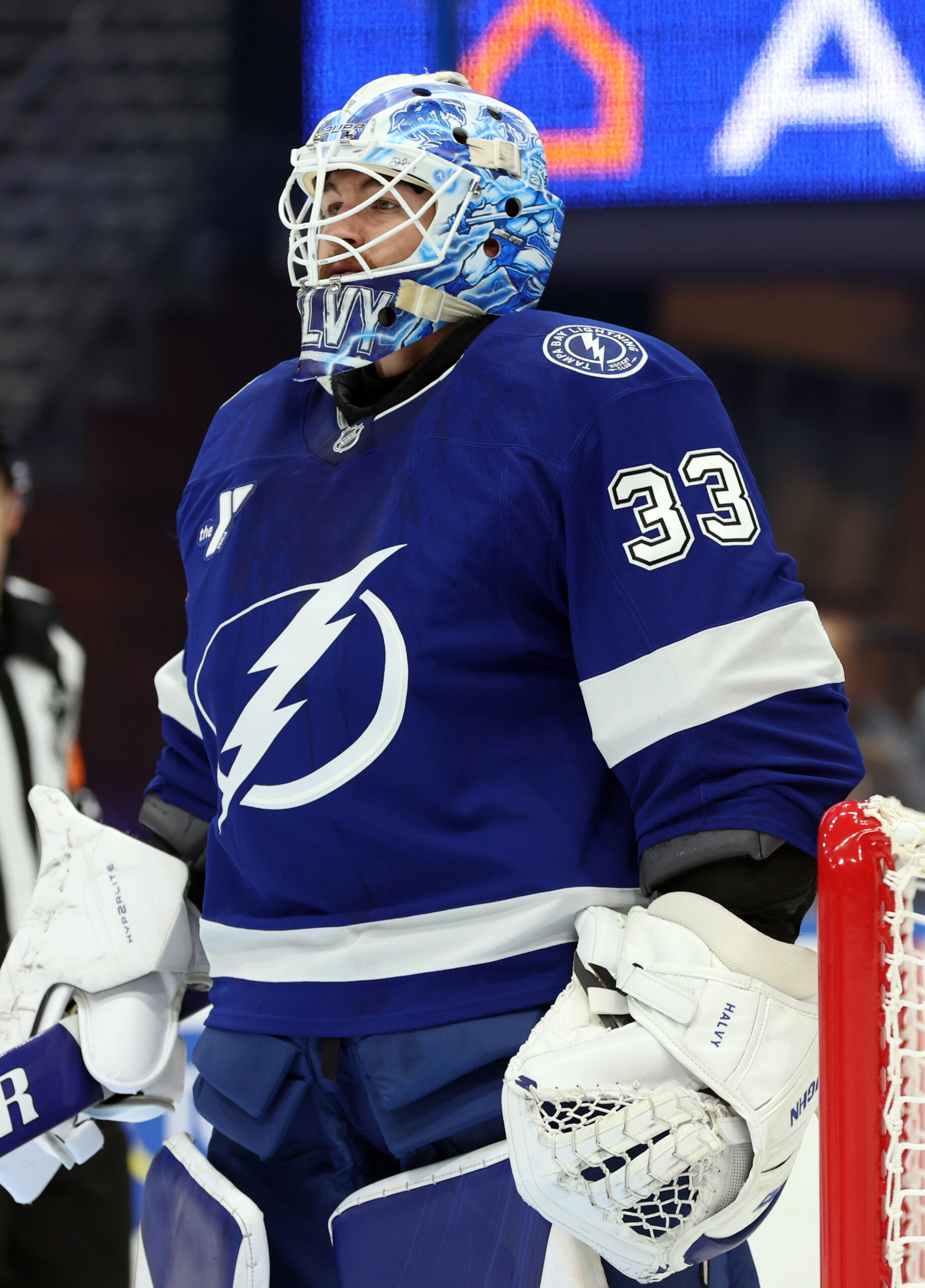
Geekie was No. 2 in scoring on the Crunch with 17 goals and 59 points in 57 games this season, while Halverson was the team’s No. 1 goalie, posting a .905 save percentage in 43 games played.
Both Geekie and Halverson have NHL experience over the last two years – Geekie played in 14 NHL contests this season, scoring three points, and had 14 points in 52 NHL games last year.
Halverson, a 30-year-old veteran, has played in three NHL contests in that same time frame.
It is significantly more likely that Geekie, the No. 10 overall pick at the 2022 NHL draft, ends up skating in playoff games for the Lightning compared to Halverson. Halverson will be Tampa’s spare third goalie, behind starter Andrei Vasilevskiy and backup Jonas Johansson, who are both entrenched in their roles.
If Halverson ends up staying on the Lightning roster for the team’s postseason run, Syracuse will likely turn to 26-year-old Ryan Fanti, a former ECHL No. 1 who posted a .905 save percentage in 27 games this season as Halverson’s backup.
Geekie’s path to NHL playing time likely depends upon the health of rookie forward Dominic James. The 23-year-old has been out since February, but was beginning to make his mark in the NHL with a goal in each of his two most recent games. James suffered a leg injury in February and underwent surgery, but appears to be nearing a return to the ice.
Eduardo A. Encina of the Tampa Bay Times reported Friday that James skated in practice as Tampa’s fourth-line center, Geekie could get a look in that role. Veteran Pontus Holmberg could also be a contender for the No. 4 center job occupied by James in practice, but he has been out since April 6 with an upper-body injury that head coach Jon Cooper called “not good.”
The trio of reassignments return three players who play key roles in Syracuse back to the AHL. Pelletier is the Crunch’s top scorer with 77 points in 63 games this season. As an offense-first 5’10” winger with zero games of playoff experience at the NHL level, it’s likely Tampa Bay stand to benefit more with Pelletier in Syracuse rather than on their playoff roster.
Chaffee, 28, scored 57 points in 54 AHL games for the Crunch this season but had just one point in 11 games with the Lightning. He does have nine games of NHL postseason experience and could be at the top of the priority order when it comes to potential recalls should Tampa Bay run into injury trouble up front.
Santini, 31, got into 12 NHL games this season, the most he’s gotten into in a single year since 2018-19. He’s an established AHL top-four defensive defenseman and is likely to play a significant role in what the Crunch hope is a deep postseason run.
Photos courtesy of Kim Klement Neitzel-Imagn Images
Central Notes: Holloway, Comrie, Heinola
There are numerous factors that contributed to the St. Louis Blues’ failure to return to the postseason in 2025-26, and one of those factors was the health of a few key contributors. One of the team’s best forwards, Dylan Holloway, was limited to just 59 games played as a result of lower-body injury issues. Set to become an RFA this summer, Holloway could be a candidate to receive a long-term extension from the club.
Blues GM Doug Armstrong spoke on that possibility in his end-of-season press conference, and made it clear that the team wants to see Holloway show he can stay healthy – and play at a consistent level – before they feel comfortable committing to a long-term contract. Per The Athletic’s Jeremy Rutherford, Armstrong said “Holloway has to prove to himself and the league that he’s an 82-game player to that level that he played at the end. I think he is, but what I think is really irrelevant — it’s what he does. That’s just an honest answer that we need consistent, 82-game play.” Holloway has been excellent at times in his Blues career, and finished 2025-26 with 22 goals and 51 points in 58 games played. His expiring contract, the offer sheet he signed when he was a member of the Edmonton Oilers, contained a $2.29MM AAV.
Other notes from around the Central Division:
- While much of the recent conversation regarding the goaltending of the Winnipeg Jets has surrounded star Connor Hellebuyck, there is also the team’s backup role to consider. Veteran Eric Comrie is a pending unrestricted free agent, but he joked with the media, including The Athletic’s Murat Ates, that he “always” finds his way back to Winnipeg. Comrie was drafted by the Jets in 2013, broke into the NHL with the team in 2016-17, left and then re-joined the team via waivers in 2019-20, did the same in 2020-21, and finally returned to Winnipeg in 2024-25 after a two-year stint with the Buffalo Sabres. Comrie’s .890 save percentage in 25 games as the Jets’ backup this season was below his career standards of performance, but his .914 mark in 2024-25 shows what he can accomplish when the Jets as a team are firing on all cylinders. Ates called Comrie a “beloved teammate” in Winnipeg and added his return on a new contract is “highly plausible.”
- One player almost certain not to return to the Jets is the team’s 2019 first-round pick Ville Heinola. Ates wrote that Heinola’s “time with the Jets is over,” and that he will prioritize playing time in his next landing spot, whether that is with another NHL club or in an opportunity in Europe. The 25-year-old got into eight NHL games just a year after he was drafted, but wasn’t able to seize an NHL role on the Jets’ defense over the course of more than a half-decade with the club. While the Jets boasted enviable defensive depth throughout Heinola’s tenure with the team, something that contributed to his inability to break into the NHL, it’s also true that Heinola struggled to develop his defensive game. He has at least shown an ability to create offense from the back end at the AHL level, such as in 2022-23 when he scored a career-high 37 points in 48 games.
Latest On Auston Matthews
Toronto Maple Leafs captain and franchise face Auston Matthews was non-committal when asked about his future in Toronto at the team’s exit day, relays The Athletic’s Joshua Kloke.
Matthews, responding to questions about his willingness to remain in Toronto for the long haul, told the media “I can’t predict the future, obviously there are steps that have to take place. [team ownership] have to hire new leadership and management. So I don’t really know.”
The news comes at the end of a nightmarish season for the Maple Leafs, one that raised questions about Matthews’ willingness to play out the final two years of his $13.25MM AAV contract in Toronto. Matthews’ season was cut short after a hit from Anaheim Ducks captain Radko Gudas left him with an MCL injury. Gudas was eventually suspended for the hit.
The 28-year-old has long been considered one of the league’s best players, and he is arguably the NHL’s most talented goal scorer.
Matthews set a career-high of 69 goals in 2023-24 and also scored 60 goals in 2021-22, the year he won the Hart Trophy.
But while individual accolades have not been difficult for Matthews to come by – he is a three-time Rocket Richard Trophy winner as well – team success has been more scarce.
While Matthews has made the playoffs every year except 2025-26, he has made it past the first round of the postseason just twice, and never past the second round. With just two years remaining on his contract, it’s likely Matthews has, or will, ask himself the question of whether he believes he can still win a Stanley Cup with the Maple Leafs. As he mentioned, that’s a difficult question to answer without knowing who will be in charge of the Maple Leafs’ hockey operations department.
But regardless of which individual takes control of hockey ops in Toronto, there are still, unfortunately, ample reasons for Matthews to take a more pessimistic view of Toronto’s short-term competitive hopes. While last season’s trade for Brandon Carlo added a capable veteran defenseman to the Maple Leafs’ lineup, it deprived the club of two of its more valuable future assets: young center Fraser Minten, as well as the team’s 2026 first-round pick. Toronto only retains its first-rounder this year if it lands in the top-five, and Toronto sits No. 5 in the draft lottery order.
With a top-five pick at their disposal, the Maple Leafs would have an immensely valuable trade chip they could use to significantly bolster their roster for next season. Conversely, if the Maple Leafs drop one spot in the order, they will hand a division rival a hugely valuable No. 6 overall selection. It’s not unreasonable to believe that the lottery could have a big impact on Matthews’ thinking regarding his own future.
In any case, there is a sentimental factor to consider when assessing Matthews’ future with the Maple Leafs. While this is not something that matters to every player, it’s worth noting that Matthews is 207 points behind Mats Sundin as Toronto’s all-time leading scorer. For someone that has already built a considerable legacy in one of the game’s biggest markets, the pull of passing Sundin could be a factor in keeping Matthews in Toronto through the end of his current deal.
From the Maple Leafs’ perspective, Matthews’ decision on his future is likely to singularly shape the team’s competitive direction. Matthews’ deal contains a full no-move clause, meaning he controls his future to an absolute degree. NHL history is littered with examples of teams being forced into sub-optimal trade returns for star players simply because those stars decide they only want to be traded to one team. That’s exactly what happened with the New York Rangers’ trade of star Artemi Panarin earlier this year, or the 2021 trade of Taylor Hall to the Bruins from the Buffalo Sabres.
These are interesting times in Toronto, first and foremost because the team’s next GM is in the process of being selected. But beyond just management changes, there could be significant on-ice changes on the horizon as well, and it all starts with a decision – either to stay, or to consider paths to exit – from the team’s captain.
Photos courtesy of Nick Turchiaro-Imagn Images
Snapshots: Team Canada, Hagens, Ott
Team Canada has secured commitments from several big-name players for the country’s team at the upcoming IIHF Men’s World Championships in Switzerland, according to Darren Dreger of TSN. Per Dreger, some of the names include: Mark Scheifele, John Tavares, Robert Thomas, and Ryan O’Reilly, with more set to be named moving forward. This quartet of centers gives the country enviable depth at one of the game’s most important positions, and also means one or two of those names could end up playing on the wing. Canada last won an IIHF Men’s World Championship in 2023.
O’Reilly, who scored 74 points in 81 games for the Nashville Predators this season, has won gold at IIHF Worlds twice in his career, and has also won a silver medal at the tournament. He was also on last year’s Canadian entry into the tournament. Scheifele, 33, scored 103 points this season and won gold in 2016 and silver in 2017, scoring 21 points across 27 career games at IIHF World Championships. Thomas scored 64 points in 64 games for the St. Louis Blues this season but has not previously represented Canada on the country’s senior men’s side. Tavares, who scored 71 points for the Toronto Maple Leafs this year, captained Team Canada at the 2024 edition of the tournament, and also played at worlds in 2010, 2011, and 2012. He led the tournament in goals in 2010.
Other notes from around the hockey world:
- Boston Bruins star prospect James Hagens will most likely be in the lineup for the first game of the team’s upcoming series against the Buffalo Sabres, head coach Marco Sturm told the media today. Hagens, 19, has gotten into two career NHL games so far and has registered one assist, playing a third-line winger role alongside Fraser Minten and Marat Khusnutdinov. Hagens scored four points in six games at the AHL level and managed 23 goals and 47 points in 34 games playing for Boston College this year. He’s been widely considered the Bruins’ top prospect since the team selected him No. 7 overall at the 2025 draft.
- The St. Louis Blues are expected to enter negotiations to retain Steve Ott as head coach of the team’s AHL affiliate, the Springfield Thunderbirds, beyond this season, per GM Doug Armstrong. Ott took over as Thunderbirds head coach in January, replacing Steve Konowalchuk, who began the season 13-18-6. Ott was able to deliver playoff hockey to Springfield, guiding the team to a 31-31-10 record as of writing, good for the final opening-round playoff spot in the league’s Atlantic Division. Ott was formerly an assistant on the Blues’ NHL staff and also had an 848-game NHL career as a player.