
Flyers Working On Long-Term Extension With Dan Vladar
The decision to sign goaltender Dan Vladar to a two-year contract last summer worked out well for both the Flyers and Vladar. Philadelphia got some more upside between the pipes while Vladar got the chance he was seeking to play a bigger role.
It’s fair to say he took full advantage of that opportunity, quickly staking claim to the starting job and running with it. Along the way, he was a key contributor in the Flyers making it to the second round of the playoffs. Extension-eligible next month, it appears he’s on his way to being rewarded for his efforts. ESPN’s Kevin Weekes reports (Twitter link) that the two sides are working on a five-year extension that, if finalized, would likely carry an AAV in the mid-$5MM range. Pierre LeBrun of TSN and The Athletic adds (Twitter link) that a sixth year could be tacked on and that there is still some work to be done before it’s finalized.
A price tag in that range would represent a well-earned significant raise on the $3.35MM he made this season and is set to make in 2026-27 as well.
 The 28-year-old hadn’t played in more than 30 games in a single NHL season heading into 2025-26. He blew past that mark by a mile, seeing action in 52 appearances, 51 of those being starts. In those outings, he put up a career-best 2.42 GAA while his .906 SV% matched his personal best from his rookie year back in 2021-22. He ranked 10th league-wide in Goals Saved Above Expected, per MoneyPuck, with a mark of 13.8. Vladar was even stingier in the playoffs, posting a 2.18 GAA and a .922 SV% in 10 outings while his Goals Saved Above Expected mark was 8.5, second-best among postseason netminders.
As they did by committing the contract they did last summer with Vladar’s limited experience, the Flyers would be taking a risk by extending him after just one strong season. On the other hand, if they were to wait and Vladar plays at a similar level in 2026-27, the price tag would undoubtedly be higher than in the $5MM range so there’s risk in waiting, too. In this case, it looks like GM Daniel Briere that the risk of signing him early is worth the potential reward for doing so.
Assuming something ultimately gets finalized on or after July 1st, the Flyers will have one half of their goaltending tandem locked up through the long haul. That would allow prospects like Carson Bjarnason or Yegor Zavragin more time to develop with an eye on one of them taking over as the backup over the next few seasons. Goaltending has been a position of some turmoil in Philadelphia for a while. Suddenly, it looks like it could become a stable spot for them in the near future.
Photo courtesy of Walter Tychnowicz-Imagn Images.
Red Wings Sign Theo Rochette
The Red Wings have added some depth up front. The team announced (Twitter link) that they’ve signed free agent forward Theo Rochette to a one-year, entry-level contract. Financial terms of the deal were not disclosed.
The 24-year-old has been on the NHL radar for a couple of years now and last month, Sportsnet’s Elliotte Friedman reported that a few teams were believed to be taking a look at Rochette. Accordingly, it’s not surprising that he was able to secure an entry-level deal this time around. His signing age limits the term of the contract to just one year compared to the standard three seasons that most players initially receive.
Rochette was an impact scorer in his junior days in the QMJHL. Over his five seasons (spent between Chicoutimi and Quebec), he tallied 115 goals and 202 assists in 271 games during the regular season while adding 41 points in 40 postseason contests. That wasn’t enough to get him drafted and somewhat surprisingly, he wasn’t able to secure an entry-level deal as an undrafted free agent at that time either.
Instead, Rochette opted to head overseas, signing a two-year deal with HC Lausanne in 2023, then inked a five-year extension after that, a deal that put him under contract through the 2030-31 campaign. Clearly, the extension also had an NHL out clause which allowed him to join the Red Wings. Rochette has played the last three years in Switzerland’s top league, recording at least 30 points in each of them while coming up just shy of a point per game this season where he had 22 goals and 21 assists in 46 games. Rochette also fared well for the Swiss at the World Championship last month, notching three goals and three assists in 10 games on a team that just came up short in the Gold Medal Game, falling to Finland in overtime.
Rochette is joining a Detroit team that has finished 22nd in the NHL in scoring in each of the last two seasons. A natural offensive player, he could have a legitimate chance to crack their roster if he can hold his own in a bottom-six role in training camp. However, he will be waiver-exempt this season which could make it a little trickier for him to break camp with the Red Wings as they could prefer to stash him with AHL Grand Rapids where he could play a much more prominent role in their lineup. Either way, while it took longer than expected for Rochette to receive an NHL contract, he now has one in hand heading into next season.
Devils Assessing Market For Jacob Markstrom
When the Devils acquired Jacob Markstrom two years ago, they were hoping to solidify their goaltending position, one that had been in flux for a little while. After a decent first season in New Jersey, now-former GM Tom Fitzgerald rewarded the 36-year-old with a two-year contract extension worth $6MM per season.
But things didn’t go as well in 2025-26. Markstrom wound up being the weaker netminder in the tandem with Jake Allen while the Devils missed the playoffs. Now, it appears that new GM Sunny Mehta is interested in shaking up the position once more. ESPN’s Kevin Weekes (Twitter link) and Sportsnet both report that the team is gauging what the trade market could be for Markstrom.
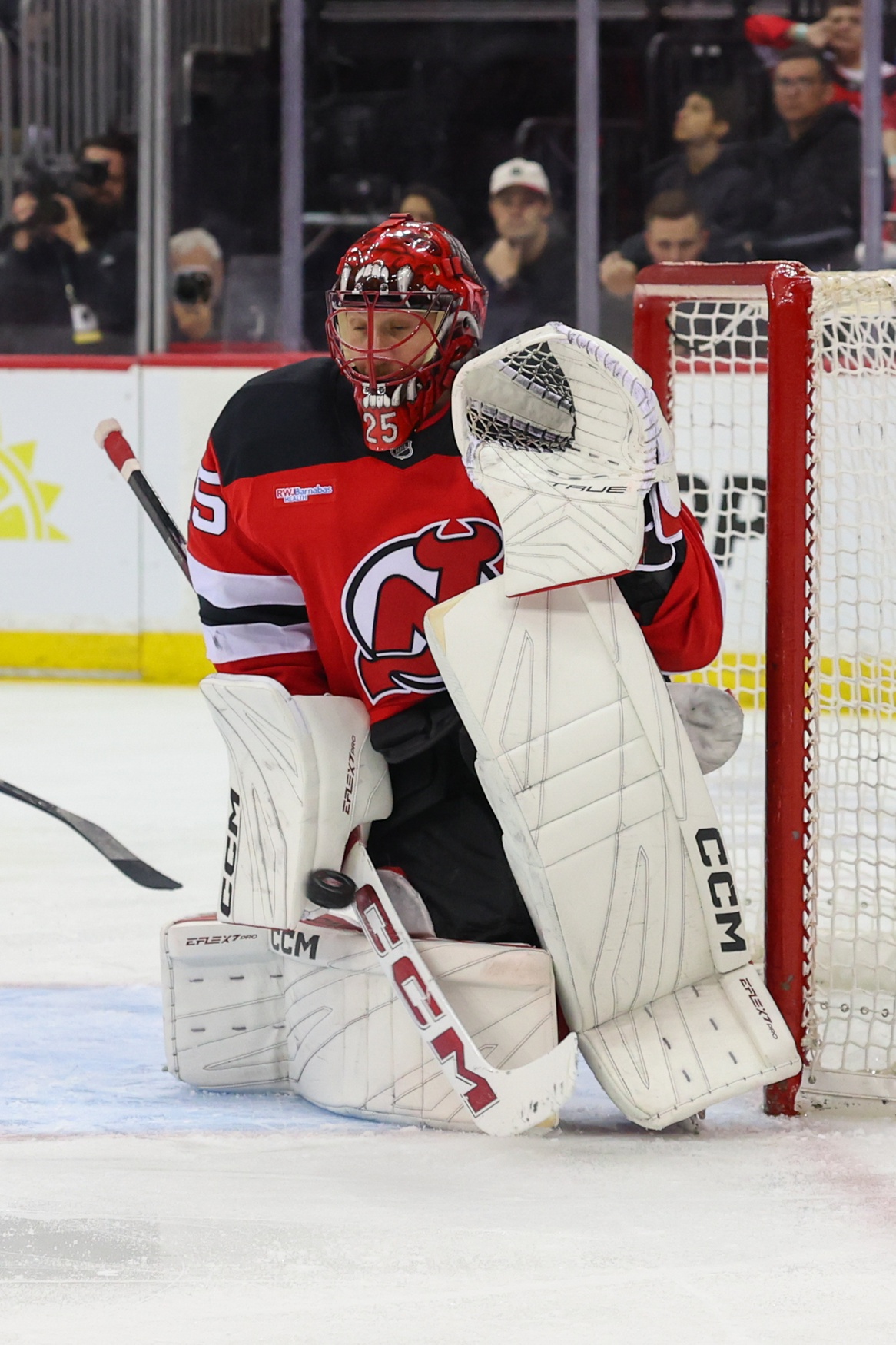 Markstrom played in 44 games this season, posting a 3.07 GAA along with a .883 SV%, his worst mark since his sophomore campaign back in 2013-14. In terms of Goals Saved Above Expected, he came in with a -11.9 rating per MoneyPuck; only nine goaltenders league-wide came in below that. Suffice it to say, the Devils aren’t exactly selling Markstrom at a high point in his value.
That said, it’s a thin free agent market for starting goaltenders with the list more or less starting and ending with Sergei Bobrovsky, who just happens to be one of the nine goalies who had a bigger negative than Markstrom in Goals Saved Above Expected. The belief is that he’s seeking somewhat of a longer-term deal despite the fact he turns 38 this fall. That has been a big holdup in why he and the Panthers have yet to work out a new contract.
Accordingly, the timing of this report makes a bit of sense for the Devils. If there’s a team wanting to add a starting goalie (with the belief he’ll rebound with a fresh start) but don’t want a long-term commitment, New Jersey can position Markstrom as that potential alternative. Again, he’s hardly worth peak value (certainly not the first-round pick plus a roster defender in Kevin Bahl that Fitzgerald gave up to get him) but if Mehta is trying to open up some cap flexibility this summer, this could be a way to do so.
Having said that, moving Markstrom would leave the Devils pretty thin between the pipes once more. Allen still has four years left on his deal but Nico Daws, once viewed as a possible longer-term option, didn’t exactly have a great showing with AHL Utica this season. With that in mind, it’s hard to think Mehta would want to go into next season with a tandem of Allen and Daws. Either a goalie would be coming back their way in any potential trade or they’d be looking to the free agent market to bring in at least a platoon partner for Allen.
It’s worth noting that Markstrom’s current deal, which runs through June 30th, carries a full no-move clause so, for the time being, he has full control over his future. However, come July 1st, his trade protection drops to a 20-team no-trade list, giving Mehta a few teams to potentially work with at a minimum. Weekes notes that no trade is imminent but Markstrom is now a name to keep an eye on in a thin goalie market this summer.
Photo courtesy of Ed Mulholland-Imagn Images.
Free Agent Focus: Pittsburgh Penguins
Free agency is under a month away, and teams are looking ahead to when it opens. Even with the UFA crop being thinned out in recent months, there will be some quality veterans set to hit the open market in July, while many teams also have key restricted free agents to re-sign. We continue our look around the NHL with an overview of the free agent situation for the Penguins.
Key Restricted Free Agents

F Egor Chinakhov – The polarizing forward immediately found new life in Pittsburgh after a December trade from Columbus, leaving him in a fascinating position this summer which already raises questions on what comes next. Shooting at 17%, there’s uncertainty on what is truly sustainable for the 25-year-old, who also went scoreless in the playoffs. Still, Chinakhov’s 18 tallies with the Penguins would rank seventh on the team, and he did so in just 43 games, with another 18 assists for 36 points. Best case for Pittsburgh is a one-year deal worth somewhere around the $3.5MM range, such that they’ll retain his restricted free agent status next year, by then able to make a safer bet on a long-term contract. It might not be that easy though, as the Russian has arbitration rights and will look for more security, and closer to $5MM, after rewarding the team with his play.
G Arturs Silovs – Another 25-year-old who made the most of a fresh start with the Penguins, the netminder played in 39 games, more than doubling his usage from 2022-25 combined with the Canucks. Silovs’ -11.9 goals saved-above-expected wasn’t glowing, paired with a 3.04 goals-against-average and .888 save percentage. A great stretch in the playoffs helped, proving his worth as a worthy pairing to the rising 22-year-old Sergei Murashov, with a nice balance of youth and untapped potential to fit in general manager Kyle Dubas‘ efforts to get younger. The Calder Cup champion would command a nice raise from his past $850k into a one-year deal worth around $1.8MM, which would allow them to put Stuart Skinner‘s hypothetical dollars elsewhere, but either way Dubas faces a decision between him or Silovs.
Other RFAs: F Ville Koivunen, D Alexander Alexeyev, G Joel Blomqvist, F Vasili Ponomarev, F Oliver Okuliar, G Filip Lindberg
Key Unrestricted Free Agents
F Anthony Mantha – It’s not often that a playoff team’s leading goal scorer walks away so decisively, but as things stand that might be the case with the 31-year-old whose 33 regular season tallies were best on the Pens. It was tremendous production considering his $2.5MM value, not expected to be much more than a middle-six depth scorer. Things weren’t so easy in the playoffs though, coming away with just one assist in six games which plays a part in his status today. Even with ample cap room, the power forward’s market value in one of the weakest free agent classes in recent memory is one that Dubas seems to be wary of. Another team could come calling with a deal taking him past age 35, worth over $6MM per season. It would be a big gamble, but Mantha has all the tools to put together a few more 25-goal campaigns, a player long thought to be capable of more than what he offered as a Red Wing or Capital.

G Stuart Skinner – Even if Dubas and the Penguins send Skinner on his way, walking for nothing in return, there’s little doubt who won the December trade with Edmonton, swapping him and Tristian Jarry. That wasn’t because the Edmonton native caught fire though; his stats regressed in Pittsburgh to a 2.99 goals-against-average and 8.3 goals saved-above-expected. As they have Murashov coming along, no long-term commitment makes sense, and as outlined above, Silovs’ slight edge in age could be favorable as well. Either way, veteran free agent counterparts such as Sergei Bobrovsky and Frederik Andersen have concerns of their own, while Skinner at 27-years-old stands out on the market. With his $2.6MM now off the books, the 6’4″ 2023 NHL All Star could get a deal similar to Petr Mrázek‘s past two-year, $4.25MM AAV agreement with Chicago, if not more term considering his younger age.
D Ryan Shea – Like many others preparing for July 1, the 29-year-old picked a great time to have a career year. In 80 games, Shea notched 35 points on 18:53 of usage. It’s production nobody would have expected from a player who had never played in more than 39 games in an NHL season, with six total points in his career prior to 2025-26. The 6’1″ lefty saw a nice jump of zone starts on the attack, up to 47.6%, an effective pairing alongside fellow UFA Connor Clifton. The duo’s efforts helped free up Erik Karlsson on his bounce back season. AFP Analytics predicts that Shea could command four years at $4.36MM per season, true top-four level. Already with fellow lefties Parker Wortherspoon and Samuel Girard in the mix, it won’t be easy, with Dubas wishing Ryan Graves‘ $4.5M AAV wasn’t a factor.
F Noel Acciari – The 34-year-old rounds out the group of “notables” over Shea’s sidekick outlined above, as he put together his second-best season as an 11-year-pro. In his third campaign with Pittsburgh, the Rhode Island native scored 13 goals with 12 helpers in 67 games. All of that came from starting an insane 84.9% of his work in his own end. Following Dubas along as a free agent from Toronto three years ago, with a three-year contract worth $2MM per, another two-year pact with around the same value is doable this summer. Pittsburgh could benefit from turning his role over to a younger player, and if so, any playoff contender would love to staple Acciari to their fourth line.
Other UFAs: D Connor Clifton, F Kevin Hayes, F Bokondji Imama, D Sebastian Aho (Sweden), F Rafael Harvey-Pinard, G Taylor Gauthier (Group 6), F Joona Koppanen
The Penguins have $37MM of cap room to work with this off-season, good for fifth-best in the NHL. Depending on what happens with Mantha and Shea, two key faces from 2025-26, there’s plenty of room to either retain them or explore upgrades who’d be less risky to hand a big ticket. A high-end top four defenseman would go a long way, as well as another top six center. There’s always the draw of going big for one last run with Sidney Crosby, Kris Letang, and Evgeni Malkin, who himself avoided making this list with his one-year extension inked in late May which very well could be the swan song. Regardless, Dubas has been disciplined in long-term interests for the Penguins, and that’ll remain the case in the coming weeks.
Image Credit: Philip G. Pavely-Imagn Images (Chinakhov), Charles LeClaire-Imagn Images (Skinner)
Afternoon Notes: Golden Knights, McCarron, Clang
Never eager to share secrets, Vegas head coach John Tortorella wouldn’t clear up speculation on his team’s lineup ahead of Game 6 tonight at home. He’ll have to choose from a pair of similar veterans, Brandon Saad or Reilly Smith, and we won’t know until they take the ice for warm-ups, as noted by The Athletic’s Jesse Granger.
Center William Karlsson’s season is expected to be over with an injury sustained in the last contest, and if Tortorella’s Knights can’t turn the tide on their three losses out of the last four in the series, they’ll be joining him in looking ahead to 2026-27. No longer the top goal scorer he was in the early Golden Knights days, Karlsson’s impact is still huge, as a pivot between Mitch Marner and Brett Howden who have been an extremely effective line.
Neither Saad or Smith will have to worry about filling his role directly; that’s expected to fall upon Tomáš Hertl. However, one of them will join the third line on Colton Sissons’ wing. For Smith, the 35-year-old hasn’t played since the opening series versus Utah. In those six games, he added two helpers, playing 13 minutes on average, 4:19 more than his teammate Saad, in the 33-year-old’s five playoff games. Saad also has two assists.
Smith and Saad have 123 and 116 playoff games to their names respectively. Either Stanley Cup champion has what it takes to step up and make an impact, but truly it will be up to the Golden Knights stars and goaltending to try and prevent Carolina from hoisting the cup on the Vegas Strip tonight, 20 years after their first.
Elsewhere across the league:
- Hulking center Michael McCarron re-signed in Minnesota on a surprising six-year contract, carrying a $3.33MM AAV with trade protection. Set to play in the state of hockey for years to come, Elliotte Friedman of Sportsnet reported that McCarron had interest from the Canucks, as well as that the Predators made a last offer before trading him to their divisional rivals for a 2028 second-rounder. According to Friedman, who told so on the DMase, Vingan & Daunic podcast, Nashville’s offer was “not even close” to what he fetched from Minnesota. A great story for a 2013 first-round pick who had looked like a bust not long ago, McCarron’s physical traits at 6’6” and faceoff skills are clearly valued as an idealistic fourth line center in today’s game. Based on both Nashville and Vancouver’s interest in the late-blooming 31-year-old despite their ongoing youth movements, it figures that both will shop for other such players on July 1.
- Anaheim Ducks goalie prospect Calle Clang has signed with Rögle BK of the SHL, the team announced today. The 24-year-old took the crease in over 100 regular season games for the AHL’s San Diego Gulls over the years but never got a shot in the NHL. Drafted by Pittsburgh in 2020, he was dealt to the Ducks organization as part of the Rickard Rakell trade in 2022. Posting an 18-9-6 record in 2025-26 with an .897 save percentage and 2.80 goals-against-average, Clang had the bulk of work during the campaign. Now he’ll return home and work alongside Arvid Holm, another netminder with North American experience. 2023 second rounder Damian Clara, who was excellent in the Olympics with Italy, leaves the Ducks’ goaltending cupboard in fine shape. Meanwhile, Clang joins a Rögle club which made it to the SHL Finals before losing in five games. He should be able to benefit from having longtime NHL defenseman Calvin De Haan as a dependable defenseman on his side in each game next season.
Defenseman Sebastian Aho Signs In Sweden
Former New York Islanders defenseman Sebastian Aho has signed with the Växjö Lakers of the SHL, the team announced today. The deal ends his nine year term in North America, the last two of which were spent with the Wilkes-Barre/Scranton Penguins of the AHL.
Today’s news is not much of a surprise, as back in February the 30-year-old was expected to return home to Sweden with Växjö. Despite playing in 129 regular season games between his last two years on Long Island from 2022-24, Aho was unable to secure another NHL opportunity. Signing with Pittsburgh for league-minimum two years ago, he did not see another shot at the highest level.
Aho put together a strong 2022-23 campaign for the Islanders, his best as a pro, notching 23 points in 71 games. He got into all six playoff contests for the club that spring, too, which caused some added difficulty for play-by-play announcers as New York took on Carolina, being defeated in six games. Of no relation to the Hurricanes star center of the same name, Aho’s puck-moving ability offers a skill not always seen as far as depth third-pairing options go, but at 5’10” 180 lbs, size held him back at the NHL level.
The type of player who often is a high scorer in the AHL, Aho dealt with injuries over the last two years with Wilkes-Barre, not managing more than 29 games in either season. The 2017 fifth-round selection recorded exactly 14 points each, passing through waivers twice as the output was not enough to catch the attention of another NHL franchise.
A product of Skellefteå AIK, the lefty will be a big addition to the Lakers whose defense corps were largely led by former Canuck and standout AHLer Brogan Rafferty last season, also featuring Keegan Lowe, son of Hall of Famer Kevin Lowe. One other expected future teammate of Aho worth mentioning is former Blackhawk and Duck Dennis Rasmussen, now 35, still a top scorer on the team. Växjö had a strong season in 2025-26, finishing third before an eventual defeat in the semi-finals, now eager to pick up an NHL-pedigree blueliner whose 190 NHL contests are a team-high.
Poll: Who Will Win The 2026 Conn Smythe?
The 2026 Stanley Cup Finals could wrap up as soon as Sunday night, with the Carolina Hurricanes holding a 3-2 advantage over the Vegas Golden Knights. Both teams have been led to the finals by standout stars, building a strong pool of Conn Smythe Trophy candidates no matter who wins the Cup.
A strong performance in the Finals is the best way to stick in voters’ minds and no player has stood out more than Hurricanes captain Jordan Staal. The 38 year old has scored six goals and seven points in five games this series. That is more than Staal had scored through the entirety of the first three rounds – when he notched five points in 13 games. Playing under the lead of head coach Rod Brind’Amour – who spearheaded Carolina’s last Cup win in 2006 – Staal has found his next gear at exactly the right time.
But – Brind’Amour didn’t win the Conn Smythe in 2006, and Staal lacks scoring across the full postseason. A better standout could be playoff scoring leader Mitch Marner, who has blossomed into a playoff star in his first postseason run with the Golden Knights. He has recorded eight different multi-point games, including two four-point performances, en route to 29 points in just 21 playoff games. Marner has looked a cut above the rest for the last two months. That standing – marked by his lofty scoring – could be enough to earn Marner the Conn Smythe regardless of the series outcome. Connor McDavid was bestowed that honor in 2024, though he finished those playoffs with an incredible 42 points in 25 games. Marner’s chances would rise significantly should Vegas mount a comeback – one that would likely be led by his electric offense.
If the trophy does land in Carolina, MVP could go to any member of the Hurricanes best line: Taylor Hall, Jackson Blake, and Logan Stankoven. The trio has clicked perfectly in the postseason. Hall and Blake lead the Hurricanes in playoff scoring with 18 points in as many games, while Stankoven ranks fourth with 15 points. Brind’Amour has leaned on this line to dig Carolina out of the defensive end and double-shift in important moments of the game. Their impact allowed the explosive styles of Nikolaj Ehlers, Seth Jarvis, and Sebastian Aho to shine. Opponents simply can’t cover all of Carolina’s top performers – and that begins with the hard-nosed impact made by each of Hall, Blake, and Stankoven.
There appeared to be a clear Conn Smythe option in Carolina’s net, before the Stanley Cup Finals. Starter Frederik Andersen was in the midst of a stellar postseason after recording 12 wins and a .931 save percentage through 13 games of the first three series. But the wheels fell off in the Finals, where Andersen recorded a .815 save percentage in 162 minutes before being pulled partway through Game 3. Rookie replacement Brandon Bussi has stood out in two-and-a-half games since. He has set a .908 save percentage and could very well end up the piece that pushed the Hurricanes over the line. That may not be enough to earn Bussi MVP consideration, though his emergence has certainly pulled down Andersen’s odds.
The top-notch, two-way impact of Mark Stone and Jack Eichel, or even the solid performances before the Finals from Vegas starter Carter Hart, could also push voters to consider their choices. A Vegas win on Sunday night could respark the debate, too, offering one more chance for players to make their case for the award. With the season set to reach its peak, who do you think will take home playoff MVP?
Who Will Win The 2026 Conn Smythe Trophy?
Blues’ Jordan Kyrou Offers Unique Trade Value
The St. Louis Blues are caught in limbo, without much momentum driving towards either a rebuild or the postseason. That stasis landed multiple Blues stars on the trade market at the 2026 Trade Deadline. Defenseman Justin Faulk took the fall, headed to a playoff-hopeful Detroit Red Wings for a rich return, though both top center Robert Thomas and veteran defender Colton Parayko also garnered trade calls.
Also on the call list was scoring winger Jordan Kyrou in the midst of a down year. Unlike Thomas and Parayko – Kyrou has stayed in trade rumors as the summer has rolled around, with NHL.com’s Stefen Rosner pondering a fit with the New York Islanders in his newsletter. Kyrou would represent another grail for St. Louis to market as they look to reinvent the lineup under rookie general manager Alexander Steen. The Blues’ search for a new direction could mean a big reward for another team.
Kyrou’s ability to score is his defining trait. He has scored 149 goals in 389 games since the start of the 2021-22 season – ranked 37th in total goals and 43rd in goals-per-game among the full NHL in that span. Flashier than his goal-scoring is Kyrou’s knack for driving play. He serves as St. Louis’ spark plug, often stepping up as the once to kickoff a change in momentum even in the midst of an 18-goal performance this season. The Blues lean on Kyrou to bring energy into the rush – and an improved ability to keep that energy up without the puck on his stick has earned Selke Trophy votes in each of the last two seasons.
That energy is also the core of Kyrou’s trade value. He is one of the NHL’s few true spark plugs who don’t also carry superstar value. Of that subgroup, Alex Tuch may be the only other option on the open market. Kyrou could be a rare crop during a dry summer – but his recent decline is the mark of serious risk. The 27 year old scored just 46 points this season – recording a point on 20 percent of goals scored by a quiet Blues offense this season. That mark represents a major drop off from recent seasons. Kyrou has chipped in on at least 28 percent of St. Louis’ goals every season dating back to 2022-23, when he led the club in scoring with 73 points in 79 games.
Now, in what should be the prime years of his career, Kyrou is running into his toughest struggles yet. Part of that sudden change is his fit in the fundamental and by-the-books systems of Drew Bannister and Jim Montgomery. The speedster struggled to hang onto his top-line role under two styles that aimed for sustained and controlled possession in the offensive zone. That worked against the creative and explosive Kyrou, though his game-changing ability still earned him rotation onto the top unit nearly every game.
Kyrou has flirted with both 40 goals and 50 assists in separate seasons through his eight-year NHL career. At 28, his chances to reach those marks will soon become dim – but his existing potential speaks to a great amount of value potentially in trade conversations. Kyrou could be a value buy who could blossom in a new setting that better supports his fast-tempo offense. Much of the NHL’s up-and-comers are now built around those styles, thanks to the breakouts of stars Matthew Schaefer, Macklin Celebrini, and Lane Hutson. All three players could benefit from the complement of another strong play-driver, while Kyrou also offers young-but-promising clubs a bit of proven impact.
St. Louis will have a rich palate after receiving a first-round pick for aging defender Faulk at the deadline. That could quickly raise the cost of a Kyrou deal – and may even require a team to send one of their NHL-ready prospects in addition to draft capital. That could quickly price out most teams – but those who see negotiations to the end will be betting on Kyrou’s untapped potential. He is signed to a very reasonable, $8.13MM cap hit through the 2030-31 season. If he reaches the heights of his scoring and lineup potential – that cap hit could quickly turn into a bargain, especially as free agents like Tuch seek eight-figure salaries.
The veracity to Kyrou’s trade rumors could be thin – but his value on the market would certainly be high. Even after a down year, Kyrou’s potential to breakout in a new system – while wielding a cost-controlled contract – could make him one of the top names to monitor through the off-season.
Bruins Sign Attilio Biasca To Two-Year Contract
The Boston Bruins have reeled in a big fish from the World Championship. Swiss winger Attilio Biasca has signed a two-year deal with the club with an annual cap hit of $980K per NHL.com’s Mark Divver. Biasca was one of Switzerland’s top wingers at the World Championship. He played alongside New Jersey Devils stars Nico Hischier and Timo Meier for much of the tournament.
Much of the Swiss team garnered attention from NHL scouts, including fellow undrafted forward Theo Rochette. Biasca managed to catch eyes despite a quiet tournament marked by only three points in 10 games. The 23 year old nonetheless brought plenty of physical impact, showing off the reliable, two-way game that earned him routine minutes in Switzerland’s National League this season.
Playing through his third season in a full-time, pro role – Biasca put up 15 goals and 27 points with HC Fribough-Gotteron this year. It was his first step away from EV Zug, the club he grew through in youth hockey before moving to the QMJHL’s Halifax Mooseheads from 2020 to 2023. Biasca was a routine scorer for the Mooseheads and spent his final year with the club with the captaincy. He totaled 81 points in 118 games in Halifax, while also posting 11 points in 13 World Junior Championships in the same span.
Three years after his final year of draft eligibility, an NHL team will finally invest in the 6-foot-1, 195-pound winger. Biasca is likely to begin his return to North America with the Providence Bruins, though his sturdy frame and reliable play away from the puck could be enough to earn a promotion into Boston’s bottom-six. That likelihood could hinge on Biasca’s ability to adjust to the speed of North American pros.
Evening Notes: Pavelski, Wranglers, Luypen
The Montreal Canadiens’ success with rookie head coach Martin St. Louis has made its ripples around the league. 2024 retiree and veteran of more than 1,300 NHL games Joe Pavelski confirmed he has spoken with the Toronto Maple Leafs about their head coaching vacancy while speaking to Curtis Pashelka of The Mercury News.
Like St. Louis before joining Montreal, Pavelski has not coached at a pro level, instead spending the years since retirement coaching his son’s 14U and 15U teams with the Madison Capitals AAA program. While that won’t lend much experience, there is no doubt about Pavelski’s experience at the top level. He was lauded for his professionalism, versatility, and hockey IQ through 16 years in the NHL – which included four years as captain of the San Jose Sharks.
Pavelski routinely rivaled 60, 70, or even 80 points each season on the back of fundamental offense. That included becoming one of the best net-front presences, and shot-tippers, in the NHL despite a sub-6-foot frame. That experience could path Pavelski into an impactful coaching role – a potential the Maple Leafs will assess through their final rounds of their hiring process.
Other notes from around the league:
- The Calgary Wranglers have hired John Dean as an assistant coach. This move will shift Dean to the pro flight after spending the last eight years overseeing the OHL’s Soo Greyhounds. He led the Greyhounds to five of a potential six postseasons in that tenure – two cancelled due to the COVID-19 pandemic – though the club couldn’t get by the second round. Dean did oversee multiple NHL prospects in his reign, including top 2026 draft defenseman Chase Reid this season. He also coached Flames players Rory Kerins and Morgan Frost, as well as top 2025 pick Brady Martin. Dean will now move to the ranks he has led many players to, taking on a pro role for the first time in his career.
- The Hershey Bears re-signed forward Jalen Luypen to a one-year, AHL contract for next season. Luypen split the 2025-26 campaign between a loan to the Tucson Roadrunners and an assignment to the ECHL. He proved much more effective in the latter setting, where he scored 14 goals and 37 points in 35 games. Luypen backed that scoring with seven points in 24 AHL games on the year. He rotated through depth roles with the Rockford IceHogs in 2023-24 and 2024-25 – and will now compete for a similar spot with a perennial contender in Hershey next season.